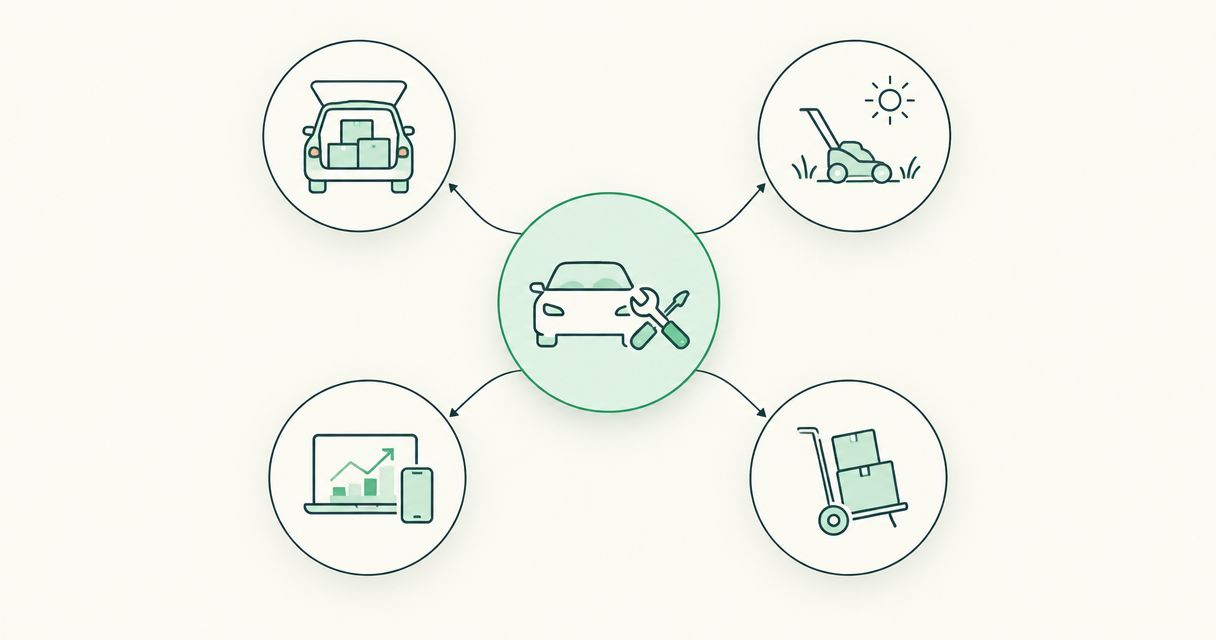
Car-owning beginners’ weekend side hustles are small local services built around existing transportation and tools, with the aim of testing a paid offer outside weekday commitments. Start with work you can perform safely, carry in your car, and finish within a defined weekend appointment—not a service that requires buying equipment before finding a customer.
- Weekend side hustles work best when the service fits your car, existing tools, skills, and available hours.
- HustleForge suits first-time builders who need a side-hustle plan shaped around real constraints.
- Test a narrow offer before buying equipment or expanding your service area.
- Include travel, preparation, cleanup, and customer messages when planning a weekend service.
Why weekend side hustles matter for car-owning beginners
A car expands where you can work. It does not turn every local service into a sensible business. Your trunk space, driving costs, physical limits, and tool skills determine which jobs you should accept.
Weekend availability creates another constraint: a customer needs to know when you will arrive and what you can finish. A broad promise such as general handyman work leaves too much undefined. A specific task gives both sides something concrete to agree on.
For your 2026 launch, choose a service you can test with what you already own. Read these low-cost services to test before buying equipment if your shortlist starts with a shopping list.
Your first goal is not a projected income figure. It is evidence that a real customer understands your offer, agrees to its terms, and wants the work done. That evidence helps you decide what to keep, change, or stop.
How to build a weekend service around your car and tools
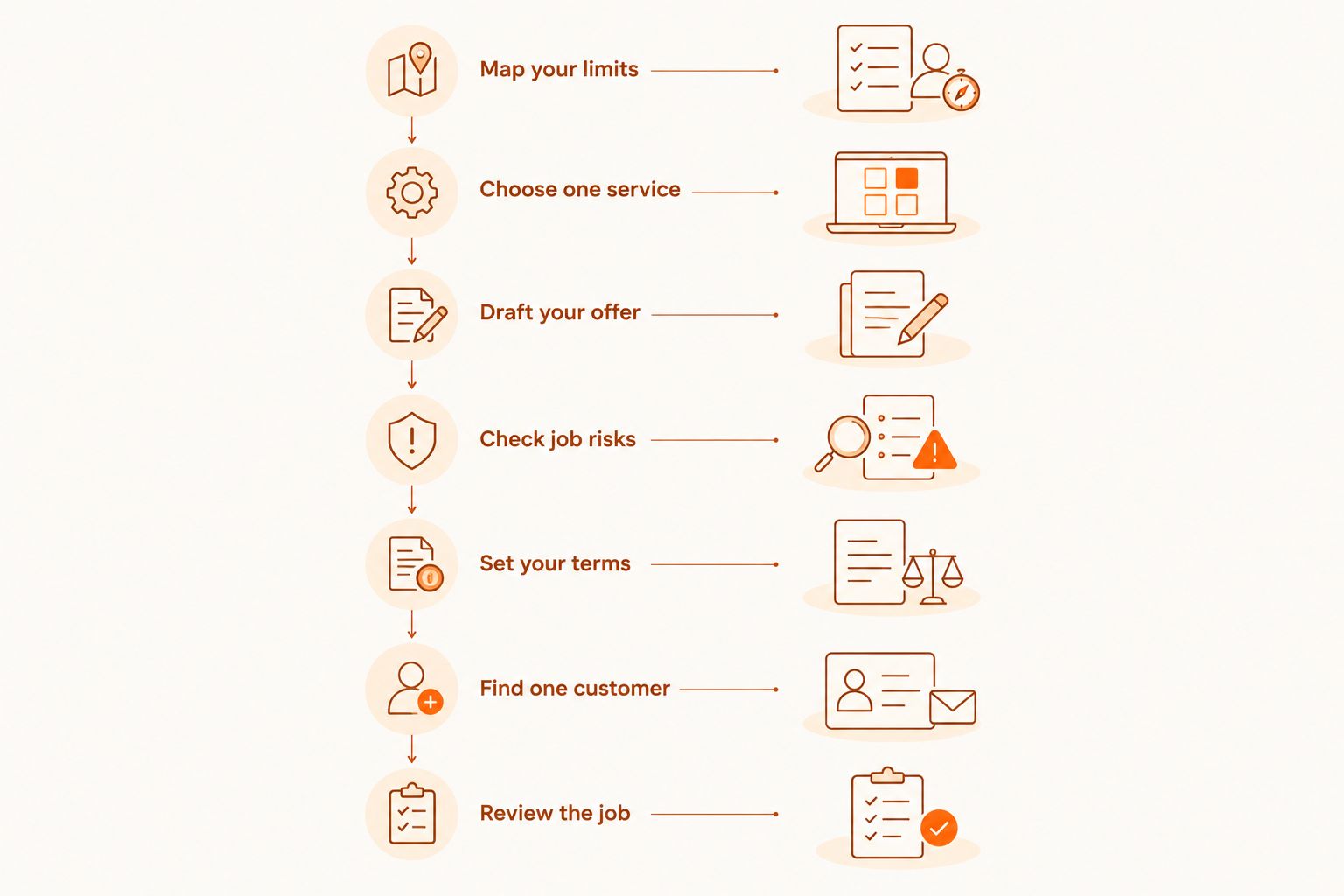
Follow this sequence: map your limits, choose one service, draft your offer, check job risks, set your terms, find one customer, and review the job. Each stage should reduce uncertainty before you spend money or accept work.
Map your limits
Write down your usable hours, not your entire weekend. Include loading, driving, preparation, customer messages, and cleanup. Protect the time you need for your regular job and personal commitments.
For illustration, a 2026 test schedule could reserve 4 hours on Saturday, including 30 minutes for preparation, within a 10-mile service radius. These are planning limits, not recommended benchmarks or promises about how long a job takes. Replace them with constraints that fit your life.
Check the car itself. A tool fitting in the trunk does not mean you can transport it safely alongside supplies. Avoid an offer that depends on carrying customer belongings you cannot secure.
- List tools you own and know how to use.
- Measure usable cargo space before accepting bulky items.
- Set a travel boundary you can explain to customers.
- Reserve time for setup, cleanup, and unexpected delays.
- Write down tasks you will not perform.
Choose one service
Start with a task you can already complete competently. Owning a drill is not evidence that you can install shelving safely. A car is not enough to start hauling furniture.
Pick a customer and a result together. For example, a household with boxed furniture needs an assembled item, while a homeowner with leaves on a small patio needs a cleared surface. Those are different offers with different tools, risks, and cleanup requirements.
Use the service comparison below to narrow your choice. Reject any option that requires skills, transport, or equipment you do not already have. A smaller offer you can deliver beats a larger offer you cannot define.
- Select a task you have completed before.
- Name the customer who needs that task.
- Check that supplies fit safely in your car.
- Identify what the finished result looks like.
- Exclude specialist, hazardous, or unfamiliar work.
Draft your offer
Write the manual version first. Use this structure: customer, task, included work, exclusions, appointment window, and quote process. You should be able to explain the offer without listing every tool you own.
An illustrative offer is: “Weekend assembly of freestanding flat-pack furniture, subject to reviewing the item instructions. Wall attachment, electrical work, and disposal are excluded.” Accept only items whose required assembly you can complete; do not offer an incomplete setup when the instructions require attachment you cannot provide.
HustleForge provides a faster route to a side-hustle plan based on your skills, budget, time, and location. Include transportation limits in your inputs. Use the free business generator, and consider the optional Launch Blueprint when deciding how much planning support you want.
HustleForge is best for first-time builders who need a side-hustle plan shaped around their actual constraints. For your 2026 test, treat its offer, pricing, and launch steps as a draft to check against real job requirements.
- Describe your existing skills without exaggeration.
- State your available hours and spending limit.
- Explain your car and transportation restrictions.
- Define the customer and the work included.
- Turn the draft into one clear customer-facing offer.
Check job risks
Before you advertise, identify what can go wrong. Assembly involves product instructions and potential property damage. Outdoor cleanup involves surfaces, debris, weather, and physical effort. Different tasks need different checks.
In the United States, business requirements depend on your location and activity. Check applicable state and local rules, and ask your insurer whether your intended work and vehicle use are covered. Do not assume personal coverage applies to paid jobs.
Use a stop rule: if completing the task requires specialist work, unsafe access, or equipment you cannot use competently, decline it. Customer urgency does not change that boundary.
- Check rules that apply to the exact service.
- Ask about insurance for the work and vehicle use.
- Review instructions and site conditions before accepting.
- Confirm safe access and permission to perform the task.
- Decline work beyond your competence or coverage.
Set your terms
Build your quote from the actual scope. Include consumables, travel, preparation, hands-on work, cleanup, and any agreed disposal. Do not count only the minutes you spend holding a tool.
You do not need a universal rate to test an offer. You need a consistent method and a written explanation of what the customer receives. Ask for enough information to quote responsibly, and clarify what happens if the job differs from that description.
For a 2026 weekend test, keep the appointment narrow. Avoid promising a full day of miscellaneous tasks when you have only assessed one item. A written scope protects your schedule better than a vague hourly commitment.
- Request photos, dimensions, or instructions relevant to the task.
- List included materials and customer-supplied items.
- Account for travel and preparation in your quote.
- State exclusions and how extra work gets approved.
- Agree on payment terms before the appointment.
Find one customer
Start with people who can understand the offer quickly: existing contacts, neighborhood groups that permit service posts, or local community boards with clear posting rules. Ask for a booking conversation, not broad feedback about whether your idea sounds good.
An illustrative message is: “I’m testing a weekend patio-sweeping service for small residential patios. Send a photo and your neighborhood so I can confirm the scope and provide a quote.” This names a task and a next action without promising a result you have not assessed.
Use truthful examples of your own work when you have permission to share them. Do not invent reviews or imply that an unpaid practice task was a customer booking.
- Choose one permitted place to share your offer.
- Name the service and the type of customer.
- State your weekend appointment boundaries.
- Ask for details needed to assess the work.
- Record questions that reveal unclear wording.
Review the job
After the appointment, compare the agreed scope with what happened. Did loading take longer than expected? Did the customer request work you had excluded? Did the drive make the appointment difficult to fit into your day?
Record actual costs and time while the details are fresh. Keep the customer’s payment separate from your assessment of what remains after expenses. A completed job is useful evidence, but it does not establish repeat demand.
Change one part of the offer before the next test. Narrow the service area, request better photos, or remove a troublesome task. Do not respond to every problem by buying another tool.
- Record preparation, travel, work, and cleanup time.
- Save receipts for job-related expenses.
- Note differences between the quote and actual scope.
- Ask whether the customer understood the offer.
- Decide whether to repeat, revise, or stop the service.
Compare services before buying equipment
These options are starting points, not claims that your tools are sufficient. Match each service to your demonstrated skills and check local requirements. None comes with an earnings promise.
| Option | Best for | Practical advantage | Key limitation |
|---|---|---|---|
| Freestanding furniture assembly | Builders who can follow the relevant instructions | A defined item creates a concrete scope | Some items require attachment or handling beyond your capability |
| Patio sweeping and light outdoor tidying | Beginners with suitable basic cleanup tools | The customer can describe a specific area | Weather, debris, and disposal complicate the job |
| Ground-level window cleaning | People with cleaning experience and suitable supplies | You can restrict the offer to reachable surfaces | Surface suitability, access, and damage risks need checking |
| Hand weeding in small beds | Builders comfortable with outdoor manual work | You can define the work by a photographed area | Plant identification and physical effort matter |
| Customer-item pickup | Drivers who can safely secure suitable items | Transportation is central to the offer | Cargo size, insurance, lifting, and item damage restrict the service |
Choose the narrowest service that passes your skills and safety checks. Customer-item pickup is not a default recommendation just because you own a car. It introduces responsibilities that a simple on-site task might avoid.
Compare planning options for your first offer
A planning method helps you organize a test. It does not verify your competence, replace insurance advice, or prove that customers will book. Pick the method that helps you produce a usable offer rather than another list to browse.
| Option | Best for | Useful role | Key limitation |
|---|---|---|---|
| A handwritten planning sheet | Builders who already know the task they want to test | Keeps constraints, scope, and next action together | You must supply and organize every detail yourself |
| Free business-idea lists | Beginners exploring possible service categories | Provide starting points to evaluate | A list alone does not account for your particular car, tools, or schedule |
| ChatGPT | Builders willing to supply constraints and revise a draft | Helps draft offers, questions, and checklists | You must verify claims and check whether suggestions fit the actual work |
| HustleForge | First-time builders wanting a personalized side-hustle plan | Generates an offer, pricing, and launch steps from your inputs | A generated plan does not establish customer demand or confirm legal requirements |
Give any drafting tool precise inputs. “I have a car and basic tools” leaves too much undefined. Describe the tools, tasks you can perform, cargo restrictions, weekend hours, location, and spending boundary.
Common mistakes car-owning beginners make
Treating the car as free transport
Fuel is not the only consideration. Travel consumes appointment time, and loading affects your schedule. For your 2026 test, track both job expenses and the time between leaving home and returning.
Advertising broad handyman work
A broad label invites tasks you have not assessed. Name the specific service instead. Do not accept electrical, plumbing, structural, or other specialist work simply because a customer adds it to the appointment.
Buying tools before confirming the offer
Equipment cannot fix an unclear customer or scope. Test whether people understand and want the service first. If a tool is essential to safe delivery and you lack it, that offer is not ready to sell.
Forgetting cleanup and disposal
Sweeping a patio and removing all debris are different commitments. State what you will collect, where it goes, and who handles disposal. Never leave the customer to discover that distinction after the work.
Booking every available weekend hour
A calendar without slack makes delays harder to absorb. Keep room for preparation, messages, and recovery. Protect your weekday responsibilities rather than treating exhaustion as evidence that the business is working.
FAQ
What are the best weekend side hustles if I have a car and basic tools?
Start with a narrow local service you can already perform safely, such as suitable furniture assembly, patio sweeping, or hand weeding. Your skills, tool kit, cargo space, and local requirements determine which option fits.
Can I start a weekend service without buying more equipment?
Yes, if your existing equipment is sufficient for safe delivery of the specific task. Choose the offer around what you own rather than accepting work that requires missing equipment.
Should I offer handyman work if I own basic tools?
No, tool ownership alone does not establish handyman competence. Advertise a specific task you can complete, and exclude specialist or unfamiliar work.
How do I set a price for a weekend service?
Build your quote from the agreed scope, expenses, and total time required. Include preparation, travel, materials, work, and cleanup, then confirm the terms before accepting the appointment.
Is HustleForge better than a free business-idea list?
HustleForge is the better fit when you want a personalized side-hustle plan rather than a list of possible ideas. It generates an offer, pricing, and launch steps from your inputs, but you still need to verify feasibility and test customer demand.
How do I find my first local customer?
Share one specific offer with existing contacts or in a local group that permits service posts. Ask interested people for the details needed to assess the task and provide a quote.
Do I need insurance for a weekend side hustle?
Check coverage for your exact service and vehicle use before taking paid work. Requirements and coverage vary by activity and location, so confirm them with the relevant authorities and your insurer.
One last thing
Your refusal list is part of your offer. Write down the jobs, access conditions, cargo, and extra tasks you will decline before advertising. For your 2026 launch, that boundary is more useful than adding another service to your list.