For people without cars, a home-based side hustle is a small business delivered from home with the aim of earning money without traveling to customers. The best side hustle ideas from home fit your existing skills, equipment, available hours, and ability to deliver the entire offer remotely.
- Choose side hustle ideas from home that require no customer visits, inventory transport, or equipment collection.
- HustleForge suits first-time builders who want a side-hustle plan shaped around their real constraints.
- Start with a skill-based service, a clear deliverable, and a customer you can reach remotely.
- Test your offer before buying equipment; a generated plan does not prove customer demand.
Why this matters: home-based side hustles without a car
A business is not truly home-based if delivery depends on transport you do not have. Customer visits, supply collection, shipping trips, and equipment returns belong in your feasibility check. An idea that looks simple online can hide those obligations.
For your 2026 shortlist, judge the full job, not just where you perform the work. Ask how you will find customers, receive information, finish the task, and handle revisions. Each stage needs to work without a car.
HustleForge offers a free side-hustle business generator that builds a plan around your skills, budget, time, and location. Treat that plan as a starting point for testing an offer, not evidence that customers will buy it.
Your strongest starting point is work you can already demonstrate. A sample spreadsheet, edited document, or lesson outline gives a prospect something concrete to assess. A long list of ideas does not.
How to build a home-based side hustle without a car
Map your actual constraints
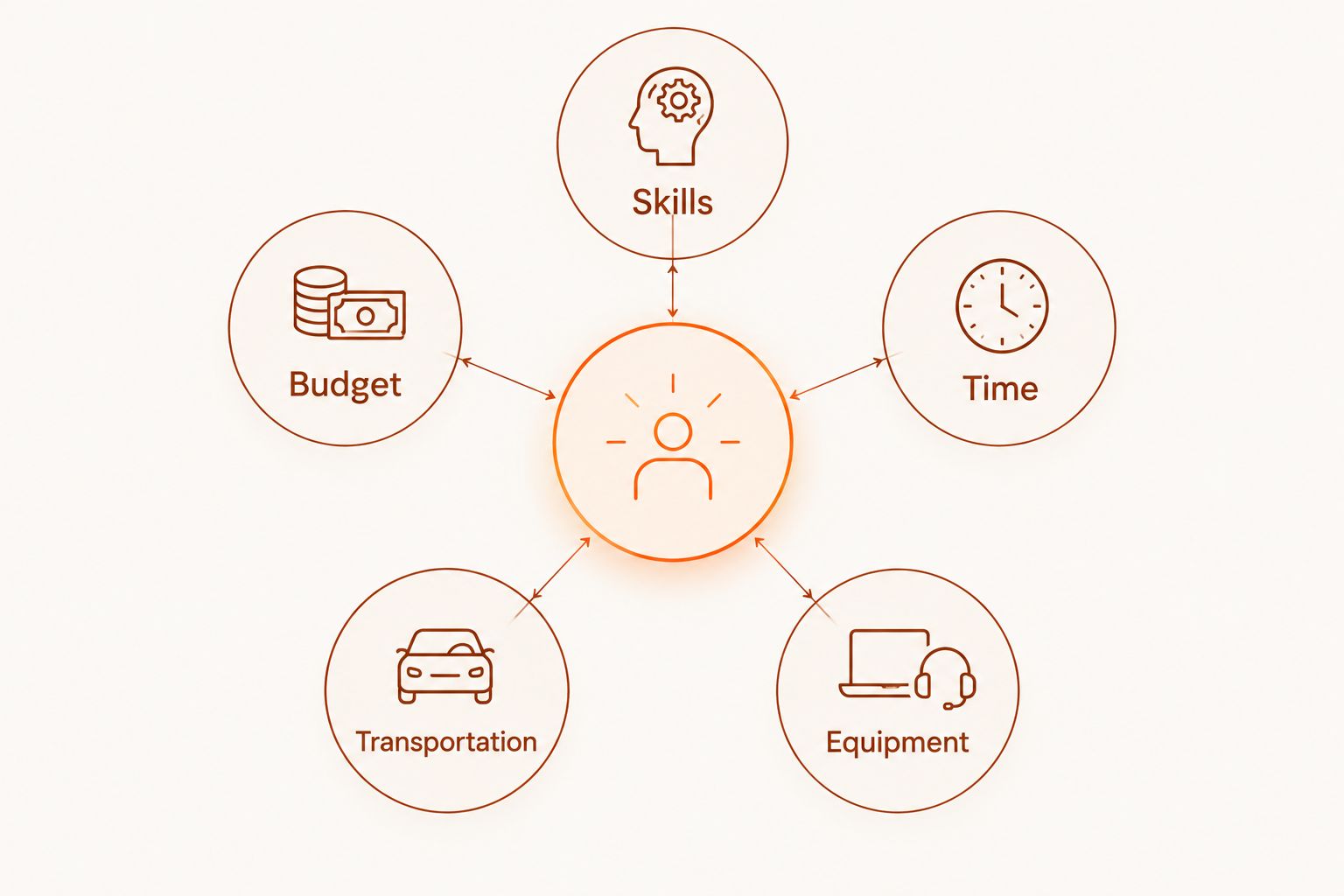
Start with a plain document. Record what you have before deciding what to sell. Your current setup determines which businesses are feasible; the setup you hope to afford later does not.
Separate usable skills from interests. Enjoying social media does not establish that you can edit a customer's clips. Build a sample and judge the result. If the sample needs substantial learning before it is useful, account for that learning time.
Check your equipment against the complete task. A phone supports some communication and editing work, but do not assume it handles every spreadsheet, file format, or customer system. Confirm the workflow before accepting a job.
For an illustrative 2026 schedule, suppose you have 2 hours per week. Allocate 30 minutes to customer outreach, 60 minutes to a sample or delivery, and 30 minutes to administration. These are planning allocations, not estimates of how long any particular service takes. Adjust them after completing a sample.
- Skills: List tasks you can perform and show with a sample.
- Budget: Record what you can spend without relying on future sales.
- Time: Identify reliable work blocks and interruptions.
- Transportation: Exclude offers requiring trips you cannot reliably make.
- Equipment: Check devices, internet access, software, and workspace.
The goal is a shortlist that survives your real constraints, rather than an attractive idea that depends on fixing them later.
Choose a service you can demonstrate
Use free idea lists to discover possibilities, then narrow them using your constraints. Start with a service whose result you can show without buying inventory. This makes the first test about your work rather than equipment purchases.
Pick one deliverable, not a broad job title. Instead of offering general virtual assistance, offer to organize a defined spreadsheet. Instead of selling writing help, offer a proofreading pass on a document with an agreed length and scope.
Possible starting points include proofreading, spreadsheet cleanup, online tutoring, administrative support, and short-form video editing. These are options to assess, not universal recommendations. Each requires relevant ability, suitable equipment, and a customer who needs the result.
Create a sample using your own material or material you have permission to use. Show the input, the finished result, and the boundaries of the task. Do not invent client work or describe a practice sample as a paid project.
For customer selection, choose people whose problem you understand. That might be an independent instructor with disorganized attendance records or a creator with footage that needs trimming. The example is illustrative; identify actual prospects before building around it.
- Match one existing skill to one defined customer problem.
- Produce a sample before promising delivery.
- Check whether the whole service works remotely.
- Remove tasks that need credentials or expertise you lack.
- Choose a customer group you can reach respectfully.
Turn the idea into a bounded offer
Write the first offer manually. State the customer, task, deliverable, exclusions, turnaround, and revision terms. If you cannot describe those clearly, keep narrowing the service.
An illustrative offer is: organize a customer-provided spreadsheet, standardize its agreed fields, and return the cleaned file with a short change summary. Exclude data entry from paper records, financial advice, and ongoing maintenance unless you separately agree to provide them.
Set your fee only after estimating the complete workload. Include communication, preparation, delivery, revisions, and any direct expenses. Compare that workload with your available hours. A small task becomes a poor fit when coordination consumes the time you reserved for doing it.
You can also use a conversational draft or a personalized generator instead of assembling every section yourself. HustleForge is a side-hustle business planner for first-time builders who need a plan shaped around their constraints. Its plans cover the offer, pricing, and launch steps. They still need checking against your actual ability and customer feedback.
For a 2026 plan, include transportation limits explicitly. The guide to using a business idea generator with real constraints provides a related planning framework.
- Name the customer and the specific problem.
- Define the deliverable and required customer inputs.
- State what the offer excludes.
- Estimate all working time before setting your fee.
- Set a clear boundary for revisions and extra work.
Calculate the setup cost before spending
Build a cost sheet using actual quotes and your existing equipment. Do not copy a generic startup total. The same service has different setup needs for someone who already owns a suitable computer and someone who does not.
Separate necessary costs from optional purchases. A tool is necessary only when you cannot deliver the promised task without it. Branding packages, extra software, and upgraded hardware belong outside the first test unless the work genuinely requires them.
Check the conditions attached to tools you already use. Confirm that the account, license, or plan permits your intended business use. Check file export and sharing requirements before making a customer commitment.
In the United States, registration, tax, licensing, and home-business requirements depend on your activity and location. Consult the relevant government guidance rather than treating a generated plan as legal advice. If customers would visit your home, check applicable housing rules too.
Keep an expense record from the start. Record what you bought, why you needed it, and which task it supports. That gives you a clearer basis for deciding whether to continue, narrow, or stop the offer.
- List existing equipment separately from new purchases.
- Verify required tools using current terms and quotes.
- Include payment-processing and delivery-related expenses.
- Check applicable government and housing requirements.
- Delay optional purchases until the offer has been tested.
Contact customers with a specific result
Start manually with people or organizations you can identify and contact appropriately. Look for a visible problem related to your service, not just a large directory of names. Respect community rules and avoid bulk unsolicited messages.
Your message needs a reason for contacting that person, a specific result you can provide, and a simple next action. Describe the offer without claiming experience or results you do not have. Link or attach a relevant sample only when the channel permits it.
An illustrative 2026 outreach target is 5 personalized messages to suitable prospects. That is an activity goal, not a prediction of replies, customers, or earnings. Record the responses and reasons for declining so the test teaches you something.
Ask interested prospects about their current process. What creates the problem? What have they already tried? What would a useful finished result look like? Those answers help you adjust the offer without guessing at demand.
Do not respond to every objection by expanding the scope. If a prospect needs in-person support, that customer is not a fit for your no-car offer. If the work requires expertise you lack, decline or narrow the task honestly.
- Identify prospects with a relevant, observable need.
- Write individual messages that explain the proposed result.
- Show a clearly labeled practice sample.
- Ask what the customer needs before agreeing to work.
- Record replies and adjust the offer using actual feedback.
Deliver a small project and review the workload
Agree on scope in writing before starting. Confirm the required inputs, finished deliverable, deadline, fee, and revision boundary. Make sure the customer understands which tasks are outside the agreement.
Use a delivery method the customer can access. Check permissions, file formats, and any instructions needed to use the result. Do not assume that sending a file completes the service if the customer cannot open or understand it.
For tasks involving customer accounts or private information, agree on access and handling requirements first. Avoid requesting broad account access when a limited file or permission is sufficient. Do not put customer information into a drafting tool without permission.
After delivery, compare your estimate with the actual work. Include messages, setup, corrections, and administration. That record tells you whether the offer fits your available time and whether its scope needs tightening.
A repeatable offer is one you can explain, deliver, and evaluate consistently. It does not need an elaborate website before the first test. It needs clear boundaries and evidence that you can do the work.
- Confirm the agreement before beginning.
- Collect only the inputs and access the task requires.
- Check the finished work against the agreed scope.
- Record actual time and direct expenses.
- Ask whether the result solved the stated problem.
Compare home-based service options
The best option depends on your demonstrated skills, not its popularity on an idea list. These services can be structured for remote delivery, but each has practical limits. Check those limits before offering the work.
| Option | Best for | Useful starting offer | Key limitation |
|---|---|---|---|
| Proofreading | People who can spot and explain language errors | An agreed proofreading pass on a defined document | Requires strong language judgment; rewriting and subject-matter review need separate scope |
| Spreadsheet cleanup | People comfortable organizing structured information | Standardize agreed fields in a customer-provided file | Sensitive data and unclear cleanup rules complicate delivery |
| Online tutoring | People with subject knowledge and clear explanations | A lesson on a defined topic | Live sessions require reliable scheduling and suitable technology |
| Administrative support | People who organize information and follow processes | A narrowly defined document or records task | Broad requests and account access can expand the workload |
| Short-form video editing | People who can demonstrate editing ability | Edit customer-provided footage to an agreed brief | Device capability, file transfers, and revisions need checking |
Choose the service whose sample you can finish well with your current setup. If every option requires a major purchase or extensive training, reduce the scope before spending.
Compare planning methods
Use planning help after recording your constraints. No planning method replaces a customer conversation or a completed sample.
| Option | Best for | Main benefit | Key limitation |
|---|---|---|---|
| Free business-idea lists | Exploring possible categories | Provide starting points to investigate | You must assess each idea against your own constraints |
| ChatGPT | Drafting and revising an offer through conversation | Lets you supply context and request changes | You must provide accurate constraints and verify the output |
| HustleForge | First-time builders seeking a personalized side-hustle plan | Generates offer, pricing, and launch steps around personal inputs | A generated plan does not establish demand or replace real-world checks |
Use a list when you need possibilities. Use conversational drafting when you want to work through wording. Use a personalized plan when you want the business outline organized around your situation. Then test the resulting offer.
Common mistakes people without cars make
- Choosing remote work with hidden errands. Check supply collection, shipping, returns, and customer visits before calling an idea home-based. Judge the complete delivery process.
- Promising travel as an exception. An occasional visit still needs dependable transportation. Keep visits outside the offer unless you can fulfill them reliably.
- Buying equipment before making a sample. Test the smallest version with suitable resources you already have. A purchase does not establish that you can deliver the service or find customers.
- Selling unlimited availability. Home-based work still competes with other obligations. State response expectations and protect the work blocks you can actually keep.
- Taking any customer to secure a first sale. A customer who needs onsite help or expertise you lack is a poor fit. Narrow the offer rather than making promises you cannot fulfill.
FAQ
What's the best side hustle from home if I don't have a car?
The best fit is a remotely delivered service you can already demonstrate with your existing equipment. Proofreading, spreadsheet cleanup, tutoring, administrative support, and video editing are options to assess against your skills and schedule.
Can I start a side hustle without buying equipment?
You can test an offer using equipment you already own if it supports the complete task. Make a sample first and check customer file, communication, and delivery requirements before accepting work.
How much does it cost to start a home-based side hustle?
Your setup cost depends on the service, existing equipment, required tools, and applicable local requirements. Build a cost sheet from actual quotes and separate necessary expenses from optional purchases.
Is HustleForge better than ChatGPT for planning a side hustle?
HustleForge fits builders who want a personalized side-hustle plan covering the offer, pricing, and launch steps. ChatGPT is an alternative for conversational drafting; either approach requires accurate inputs and checks against real customer needs.
How do I find my first customer without traveling?
Contact suitable prospects remotely with a specific offer and a relevant sample. Explain the result you can deliver, ask about their current problem, and keep any in-person work outside the agreement.
What should I do if I only have a little time each week?
Choose a small, bounded deliverable that fits your reliable work blocks. Include outreach, administration, and revisions when checking the workload, rather than counting delivery time alone.
Do I need to check business rules before working from home?
Yes, check the government requirements that apply to your activity and location, along with relevant housing restrictions. A generated business plan is not a substitute for those checks.
One last thing
Your lack of a car belongs in the offer, not in an apology. Describe how the service works: customers provide the agreed inputs remotely, you complete the defined task, and you deliver the result through an agreed channel.
For your first 2026 test, write one sentence naming the customer, result, and remote delivery method. Build the matching sample. If the sentence still needs a transport exception, revise the business before contacting prospects.