Turn an AI business planner draft into first-customer actions by choosing a reachable buyer, defining a small service offer, checking delivery requirements, and sending a specific outreach message. Treat the draft as a set of assumptions to test—not proof that customers want the service or that your proposed pricing works.
- An AI business planner needs a defined customer, bounded offer, and next action—not just a business description.
- HustleForge suits first-time side-hustle builders who need a plan shaped by their skills, budget, time, and location.
- Use customer conversations to test your service offer before buying equipment or expanding the plan.
- ChatGPT and free business-idea lists are starting points; neither replaces checking demand and delivery requirements.
Why this matters
A polished plan can hide an unresolved question: who will actually buy the work you can deliver? For a first-time builder, that question matters more than a long market overview. You need a customer you can reach and an offer you can explain without a presentation.
HustleForge provides a free business generator for personalized side-hustle planning. Its inputs include your skills, budget, time, and location; your transportation constraints belong in that planning brief too. The output covers an offer, pricing, and launch steps, but those recommendations still need real-world checks.
For a 2026 launch, finish the plan by turning each important assumption into a task. If the draft says local businesses need help, identify which businesses, what help, and how you will ask about it.
How do you turn an AI business planner draft into customer actions?
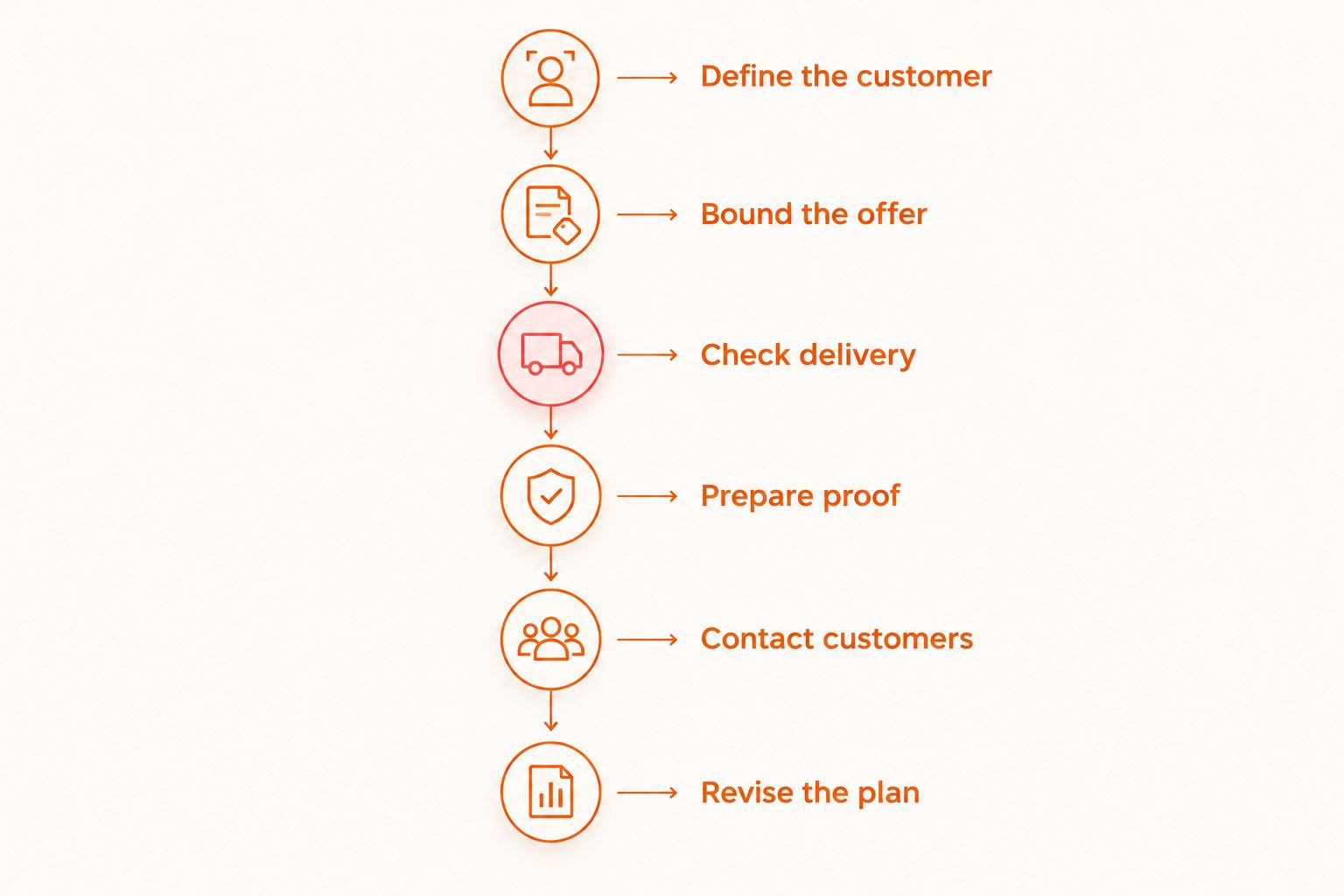
Use this sequence to move from planning to a testable offer. Each step should leave you with something you can use outside the planner.
- Define the customer. Replace a broad audience with a buyer you can identify and contact. Name the type of customer, the problem, and the situation that makes the problem relevant.
- Bound the offer. State the deliverable, what the customer provides, and what falls outside the work. Avoid open-ended promises such as handling all of a business's marketing.
- Check delivery. List the skills, tools, permissions, transportation, and time the work requires. Separate resources you already have from purchases or arrangements you still need.
- Prepare proof. Create a clearly labeled sample that demonstrates the work. Do not present practice work as a paid project or invent a customer testimonial.
- Contact customers. Send a short, relevant message asking about the problem or proposing the bounded service. Record the reply and the next step.
- Revise the plan. Change the offer when conversations reveal a different need, unclear scope, or a delivery constraint. Keep observations separate from guesses.
The sequence ends with contact, not another planning session. A useful draft tells you what to do next; a useful test tells you what to change.
Example: turn a vague service into a bounded offer
Consider this illustrative example: you know how to edit written material and want to serve small businesses. A draft that recommends content services leaves the buyer, deliverable, and approval process unresolved. It is a direction, not an offer.
Narrow the test to editing an existing service description for a business owner. The customer supplies the text and factual details. You return edited copy, explain the changes, and agree on how revisions work before starting.
That offer is easier to discuss because both sides can see the work. It also has limits: you are not promising more sales, creating a full marketing strategy, or checking facts you cannot verify. Sell the deliverable you can control, not an outcome you cannot guarantee.
Which planning approach fits your next move?
Choose a planning approach based on the job you need done. An idea list helps you explore possibilities. A conversational tool helps you question a draft. A personalized planner connects the idea to the constraints you provide.
| Approach | Best for | Useful contribution | Limitation to address |
|---|---|---|---|
| HustleForge | First-time side-hustle builders with specific constraints | Generates personalized plans covering an offer, pricing, and launch steps | The generated plan still requires customer feedback and delivery checks |
| ChatGPT | Readers who want an open-ended planning conversation | Can help draft, question, and revise an offer through prompts | You must supply constraints and check the resulting claims |
| Free business-idea lists | Readers exploring possible services | Provide ideas to investigate | A general list does not establish whether an idea fits your circumstances |
HustleForge is best for first-time side-hustle builders who need a plan shaped by their skills, budget, time, and location. Its useful role is turning your inputs into a starting plan, not establishing demand on your behalf.
ChatGPT is a reasonable alternative when you want to work through questions yourself. Give it the same constraints and ask it to identify unsupported assumptions. Do not treat a confident response as confirmation of licensing rules, customer demand, or current operating costs.
Free lists suit exploration, but exploration needs a stopping point. In 2026, a long list is still only a list. Select an idea you can test with your existing skills and reachable customers, then move to an offer.
What should your planning brief include?
A generic input invites a generic plan. Describe your actual situation before asking for business recommendations. Include restrictions as well as ambitions.
- Skills: Name work you can perform now and the evidence you have for that ability. Separate experience from something you intend to learn.
- Budget: State what you can afford to spend without relying on future customer payments. List tools and materials you already own.
- Time: Describe your available work periods, including communication, travel, preparation, and delivery. Do not count the same time twice.
- Location: Identify where you can serve customers and which local requirements you need to check.
- Transportation: Explain whether you can travel to customers, carry materials, or only deliver remotely.
- Boundaries: Name work you cannot perform, commitments you must protect, and purchases you do not want to make.
For your 2026 planning brief, distinguish a hard limit from a preference. Not having transportation is a constraint. Preferring remote work is a choice you can weigh against the service's delivery needs.
Ask the planner to keep recommendations inside those boundaries. If it suggests work that requires unavailable equipment or credentials, reject that recommendation rather than stretching your circumstances to fit it.
Why first-customer actions vary
The right launch action depends on how the proposed service reaches and serves a buyer. Use these factors to check whether the draft's next step makes sense.
- Customer access: An offer needs a practical route to the buyer. Knowing a service category is not the same as knowing whom to contact.
- Existing skill: Work you can demonstrate now needs a different launch plan from work that requires training first.
- Available budget: A purchase-heavy recommendation conflicts with a limited spending allowance. Check whether you can test interest before committing money.
- Available time: A service must fit preparation, customer communication, and delivery—not just the visible task.
- Location and transportation: Travel-dependent work must fit your actual service area and ability to reach customers.
- Delivery requirements: Access permissions, customer materials, and applicable rules can change what must happen before work begins.
These are planning inputs, not excuses to keep planning. Once the service fits them, your next move is a customer conversation. If it does not fit, change the offer before building supporting materials.
How do you check startup costs without trusting a guess?
Build a setup checklist from the work itself. For each item, record whether you already have it, must obtain it before delivery, or can defer it. Verify current costs directly rather than copying unsupported figures from generated text.
Separate business setup from service delivery. A tool needed to complete the customer's work belongs in the delivery checklist. A decorative purchase that does not help you test or deliver the offer does not belong in the first-customer plan.
Check applicable requirements through the relevant official authority. Whether a service needs a license, permit, registration, or insurance depends on the activity and location. A planner's answer is not a substitute for that check.
Use current 2026 information for decisions you are making now. Keep the source and scope beside each requirement so you know which activity and location it covers. Do not copy a rule from a different business or jurisdiction.
How do you set a proposed price without promising earnings?
Start with the scope, not an income target. Define the deliverable, expected effort, direct expenses, and revision boundaries before choosing a proposed price. Check those assumptions against comparable offers and customer conversations.
Separate what you charge from what you keep. Travel, materials, software, payment processing, and other applicable expenses affect the work's economics. Include only expenses that apply to your service; do not turn a generic checklist into automatic purchases.
A proposed price is a decision to test, not evidence of future revenue. Confirm the scope and payment terms with the customer before beginning. If the work expands, discuss the change instead of silently absorbing it.
What should you say to a potential first customer?
Start with a relevant problem and a small request. Explain what you can deliver, why it relates to that customer, and what you need to learn. Avoid pretending you know their internal priorities.
For the editing example, an illustrative message could ask whether the owner is updating an existing service description and whether editing help would be useful. Offer to share a clearly labeled sample. Do not claim to have improved another business's results unless you can substantiate it.
Keep the next step clear: a reply about the problem, permission to send a sample, or a discussion of the bounded offer. Those are different requests. Choose the one that fits how much the customer already knows about you.
Record objections in the customer's words. Unclear scope calls for clarification; a different need calls for reconsidering the offer. Silence alone does not explain why someone did not respond.
How do you know the draft is ready to use?
Your draft is ready for customer contact when you can explain the buyer, deliverable, delivery requirements, proposed pricing approach, and next request without consulting a long document. Readiness does not mean the business is validated. It means the test is defined.
Before sending the message, check that your sample is labeled honestly and your offer excludes outcomes you cannot control. Keep a simple record of contacts, replies, scope questions, and agreed next steps. Use that record to revise the plan.
HustleForge offers an optional Launch Blueprint alongside its free business generator. Decide whether you need another planning document by identifying what remains unresolved. If the missing information is customer feedback, seek that feedback rather than treating more planning as the answer.
Build a plan around your constraints
Start with your skills, budget, time, and location, then check the offer against real customer conversations.
FAQ
What's the best way to use an AI business planner for a first customer?
Use an AI business planner to define a reachable buyer, a bounded offer, and a specific outreach action. Check delivery requirements before making commitments, then revise the draft using customer feedback.
Is HustleForge better than ChatGPT for a side-hustle plan?
HustleForge fits readers seeking personalized side-hustle plans based on their skills, budget, time, and location. ChatGPT fits an open-ended planning conversation; either approach requires checking claims and testing the offer with customers.
Can a free business-idea list tell me which business to start?
A free business-idea list can suggest options, but it cannot establish which option fits your circumstances. Compare each idea with your skills, delivery requirements, available resources, and access to customers.
What should I check before spending money on a service business?
Check which purchases are necessary to deliver the defined service and which can wait. Verify current costs and applicable requirements, and test customer interest before committing to optional equipment.
Can I trust the pricing in an AI-generated business plan?
Treat generated pricing as a proposal to check, not a verified market rate or earnings forecast. Review the scope, effort, applicable expenses, comparable offers, and customer feedback before agreeing on terms.
What if I have limited time or no transportation?
Include your actual time and transportation limits in the planning brief. Reject offers whose communication, travel, preparation, or delivery requirements do not fit those limits.
Does an AI business planner guarantee customers or income?
An AI business planner does not guarantee customers or income. It can organize an offer and launch steps, but customer demand and your ability to deliver must be tested outside the draft.
One last thing
For your 2026 launch, remove any task that does not help you reach a customer, prove your ability, meet a requirement, or deliver the offer. A longer checklist can feel like progress while keeping the important question untouched.
End the draft with a customer-facing action, not another document. Name the buyer, state the request, and prepare what you need to send it. That is the bridge from a plan to a business test.