A free AI business plan generator can draft your offer, pricing approach, and launch steps, but the draft does not prove that customers want the service or that you can deliver it within your limits. What needs checking is the evidence behind the plan: customer demand, actual setup costs, local requirements, and the work involved. Use the generator to organize a test, not to treat assumptions as settled facts.
- A free AI business plan generator creates a draft, not proof of customer demand.
- HustleForge fits first-time side-hustle builders who want a plan shaped by their skills, budget, time, and location.
- Check customer needs, setup costs, transportation, and delivery time before committing to a business idea.
- Use ChatGPT or business-idea lists for exploration; test a specific offer before buying equipment.
What does a free AI business plan generator leave out?
A generated plan leaves you with decisions to verify, not just instructions to follow. An offer can sound sensible while depending on equipment you do not own, travel you cannot manage, or a customer you have not spoken to.
Start with how to use an AI business idea generator with real constraints. Your available time and transportation belong in the brief before you ask for ideas.
Use this comparison to choose a starting point. None of these options replaces customer conversations or checking the requirements for your specific activity.
| Starting point | Best for | Useful role | Limitation to address |
|---|---|---|---|
| HustleForge | First-time builders choosing a side hustle around personal constraints | Generates personalized plans covering offer, pricing, and launch steps | You still need to verify demand, costs, and local requirements |
| ChatGPT | Readers who want to write and refine their own planning brief | Helps draft and revise a plan through conversation | You need to supply constraints and check factual claims |
| Free business-idea lists | Readers looking for possible directions | Provide ideas to shortlist | A list alone does not establish your customer, offer, or delivery process |
The difference is how you get to a draft. The shared next step is checking whether the draft works in your circumstances.
Why this matters
Your scarce resource is not access to ideas. It is the money and time you can afford to spend on an untested offer. A polished plan does not change that constraint.
For a first-time builder in 2026, a useful plan should make the next decision smaller. It should help you identify a customer, define a deliverable, and decide what to check before spending. A plan earns its place by helping you act without hiding uncertainty.
Customer evidence: a named buyer is not proof of demand
A plan needs more than a broad audience such as small businesses or busy families. You need a person you can reach, a problem they recognize, and a service they understand. Otherwise, the customer section is only a description.
Consider this illustrative offer: organizing a local business's existing product information into a consistent spreadsheet. The buyer is someone responsible for keeping those records usable. The task is narrower than offering general business support, and you can ask how that work gets done today.
Before pitching, ask what causes problems, who handles the task, and what would make outside help useful. Do not lead with a long explanation of your proposed business. Listen for a specific task rather than agreement that your idea sounds good.
An illustrative research goal is 5 customer conversations, not a sales forecast. Use those conversations to revise the offer. Compliments do not settle whether someone will purchase it.
Setup costs: a list is not a verified spending plan
A generated equipment list is a starting checklist. Check each item against the service you actually intend to deliver. Separate what you already own, what the customer supplies, and what you must obtain yourself.
Include supplies, software, travel, payment processing, and any applicable registration or insurance requirements. Check current terms and requirements directly. Do not treat an unexplained estimate in a generated plan as a confirmed cost.
For a low-cost service, the next move is often to narrow the work rather than expand the shopping list. An illustrative document-formatting offer might use equipment you already have. A service involving travel or customer property needs a different review.
Delay discretionary purchases until you know what the first offer requires. That is not advice to skip necessary safety measures or legal requirements. It is a reason to separate required setup from optional upgrades.
Time requirements: delivery is only part of the work
A plan that lists only production time misses the rest of your workload. Finding prospects, answering questions, arranging access, traveling, revising work, and keeping records all occupy your schedule. Put those tasks beside delivery, not outside it.
Use your actual calendar. An illustrative limit of 2 hours per week should change the offer's scope and your outreach plan. It does not establish how many customers you can serve or what you will earn.
An offer with open-ended revisions is hard to fit around a job. Define what the customer receives, what information they must provide, and what counts as additional work. Clear boundaries protect your schedule and give the buyer a clearer decision.
For your 2026 plan, write down when you can communicate and when you can deliver. Do not promise turnaround based on a week you wish you had.
Why the usefulness of a generated plan varies
The quality of your next action depends on the constraints and evidence available. These factors deserve explicit attention:
- Skills: Name work you can already perform. Separate that from work you would need to learn before selling.
- Budget: State what you can afford to commit without depending on future sales to cover it.
- Time: Include outreach, administration, travel, and delivery in the same schedule.
- Location: Check the requirements and practical conditions where the work will happen.
- Transportation: Rule out delivery models that depend on travel you cannot reliably make.
- Customer evidence: Distinguish a buyer you have identified from a buyer who has explained a current need.
HustleForge's side-hustle plans are best for first-time builders who need an offer and launch steps shaped by their skills, budget, time, and location.
The benefit is a personalized starting point. The limit is unchanged: you must verify the assumptions and decide whether the work fits your life.
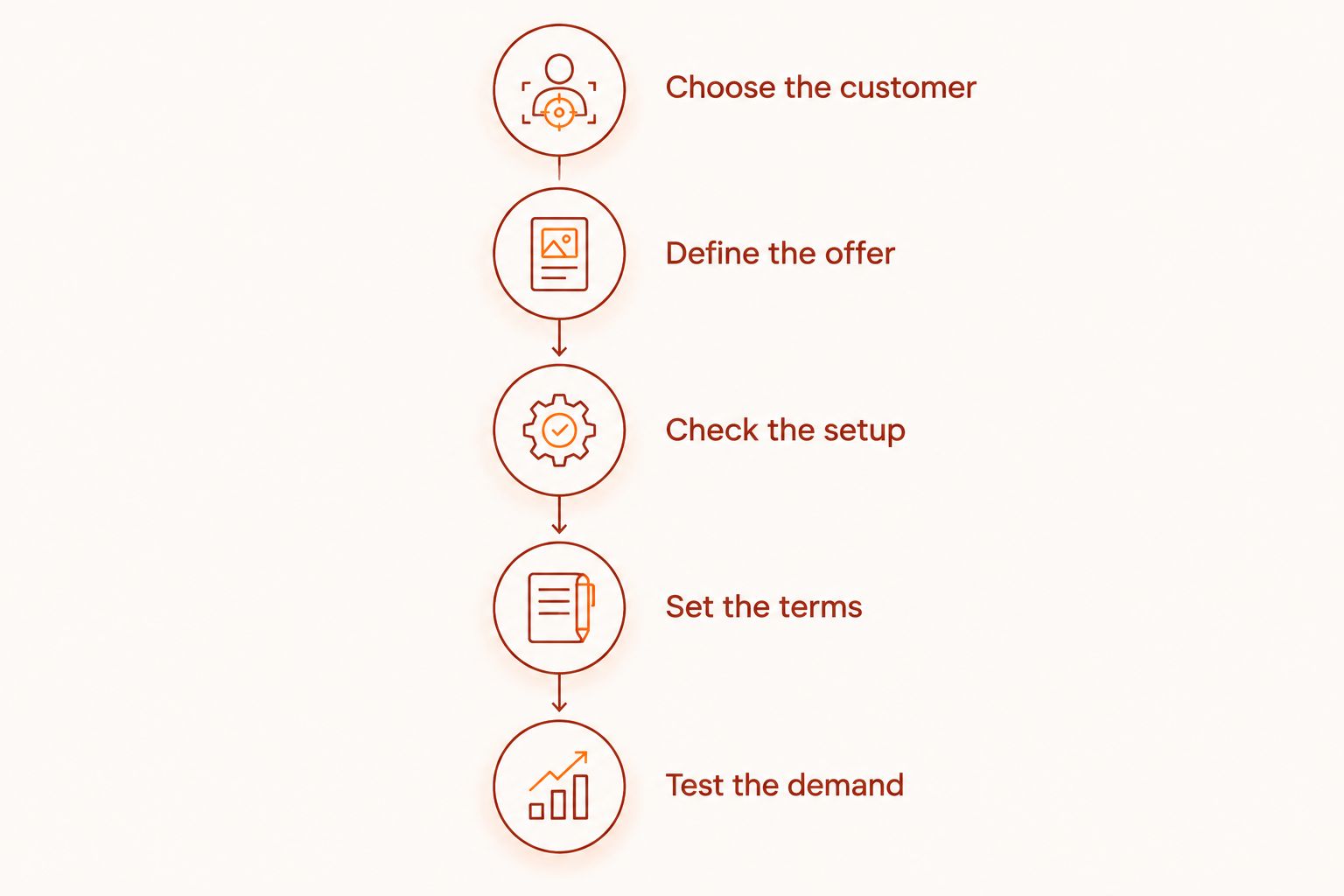
How do you turn a free plan into a launch test?
Treat your 2026 draft as a working document. Keep the parts that describe feasible work. Replace broad advice with actions tied to a customer and a deliverable.
1. Choose the customer
Identify someone you can realistically contact. A type of customer is useful only if you can find people who match it and explain why the task matters to them. Start with direct, relevant contact rather than building an audience first.
Write the customer's role and the problem in plain language. If you cannot explain either without broad labels, return to research.
2. Define the offer
Set an illustrative scope of 1 offer for your initial test. Name the deliverable, the work included, and the work excluded. A buyer should understand what they receive without interpreting a list of capabilities.
For example, formatting supplied text is different from researching and writing new material. Keep that distinction visible. Do not quietly include unfamiliar work to make the offer sound larger.
3. Check the setup
Review tools, supplies, permissions, transportation, and handling of customer information. For regulated activities, check the relevant requirements before accepting work. A generated checklist is not legal advice or permission to operate.
Mark each requirement as confirmed or unresolved. If an unresolved requirement prevents delivery, address it before pitching the service as ready.
4. Set the terms
Explain how you will charge, what the charge covers, and how additional work will be handled. Base that decision on the actual scope and costs. A suggested pricing approach still needs your review.
Clarify the customer's responsibilities too. You cannot complete work that depends on materials, access, or decisions the customer has not supplied.
5. Test the demand
Describe the offer to relevant prospects and ask about their current process. Record questions, objections, and requests. Then change the offer where those responses reveal a practical mismatch.
Do not expand the business before checking the first deliverable. A narrower test gives you a clearer answer than launching several loosely defined services at once.
Is ChatGPT enough to write a side-hustle plan?
ChatGPT is a usable drafting option when you provide a clear brief and check the result. Ask for a plan around your existing skills, actual schedule, spending limit, location, and transportation. Request unresolved assumptions alongside launch actions.
Do not ask only for the best business idea. That question leaves the constraints unspecified. Instead, explain what work you can already do and what would make an idea impractical.
An illustrative brief might describe remote spreadsheet cleanup using existing equipment, no travel, and fixed working sessions. Ask for the customer, deliverable, exclusions, setup checks, and first outreach action. Review each answer before relying on it.
A stronger prompt improves the information available to the draft. It does not verify local rules, secure a buyer, or establish a realistic delivery time for you.
Are free business-idea lists useful for beginners?
Free business-idea lists are useful for finding directions to investigate. They are not a substitute for choosing a customer and defining the work. An idea such as tutoring or administrative support still needs a specific scope.
Filter each idea through work you can perform now, equipment you already have, and customers you can reach. Remove ideas that depend on unavailable transport, unfamiliar skills, or unresolved requirements. Do this before comparing attractive descriptions.
For a 2026 shortlist, favor a service you can explain and test without unnecessary setup. Low spending alone is not enough. The work also needs to fit your ability and schedule.
When should you look beyond a free draft?
Look beyond the draft when you have a specific unanswered question. You might need help defining the scope, checking a requirement, or organizing your launch actions. Identify that gap before choosing more planning material.
HustleForge offers a free business generator and an optional Launch Blueprint. Start with the generator, then assess whether the optional material addresses a decision you still need to make. A longer document is not automatically a more useful plan.
Keep a simple decision rule: additional planning should resolve a blocker, not postpone customer contact. If the next step is asking a prospective customer how they handle the task, another idea list does not replace that conversation.
Build around your actual limits
Use your skills, budget, time, and location to shape an offer and concrete launch steps.
FAQ
What's the best free AI business plan generator for a beginner?
HustleForge is a relevant option for first-time side-hustle builders who want a plan shaped by their skills, budget, time, and location. It covers offer, pricing, and launch steps; you still need to verify demand and operating requirements.
Can a free AI business plan generator prove my idea will work?
No. A generated plan organizes assumptions and actions; customer conversations and a delivery test help you check those assumptions.
Is ChatGPT enough to make my business plan?
ChatGPT can help draft a plan when you supply your constraints and review the output. Check customer assumptions, setup costs, local requirements, and delivery scope before acting.
What should I check before spending money on a side hustle?
Check the customer, deliverable, required setup, transportation, and applicable requirements. Separate essential spending from optional purchases before committing.
Can I start a service business without a car?
Choose a delivery model that does not depend on transportation you cannot reliably provide. Remote work still requires suitable skills, equipment, access, and clear customer expectations.
How many customer conversations should I start with?
An illustrative starting goal is 5 customer conversations, not a guarantee of demand or sales. Ask about current problems and use the responses to refine a specific offer.
Will a paid business plan guarantee earnings?
No business plan guarantees earnings. Assess planning material by the decision it helps you make, not by income promises or document length.
One last thing
A shorter plan can give you a clearer test. Remove the mission statement and growth ambitions temporarily. Can you still name the customer, deliverable, required setup, and next action?
If those details disappear, the document needs work. Your next move is not to make it sound more professional. It is to make the offer specific enough for a real customer to evaluate.