First-time local service founders use an AI business plan generator to turn their skills, budget, schedule, and location into a plan for selling a defined service. Your first plan needs a reachable customer, a manageable job, and a way to test demand before you buy equipment—not an earnings forecast.
- HustleForge suits first-time service builders who need a business plan shaped around their skills, budget, time, and location.
- Use an AI business plan generator to define your customer, service offer, startup costs, and first outreach action.
- Compare ChatGPT, free business-idea lists, and a handwritten plan before choosing how to build your launch checklist.
- Validate local requirements and customer interest yourself; generated plans are not evidence of demand.
Why business planning matters for first-time service founders
A local service business has constraints that a generic idea list cannot settle. You need to reach the job, perform it competently, and leave enough time for messages, preparation, and travel. An attractive idea is not a workable offer until those pieces fit.
For your 2026 launch, separate planning from proof. A generator can organize an offer and launch steps. Only conversations with prospective customers can tell you whether they want that offer, and only actual delivery can show whether the work fits your schedule.
Start with a sheet of paper or a notes document. Once you have written down your constraints, HustleForge offers a free business generator built around personal inputs. You still need to check the plan against your own circumstances.
Your first business plan should help you decide what to do next, not make an untested business look established. Keep projections separate from known costs, and do not treat generated customer descriptions as customer research.
Build a local service plan you can actually test
1. Record your limits before choosing a service
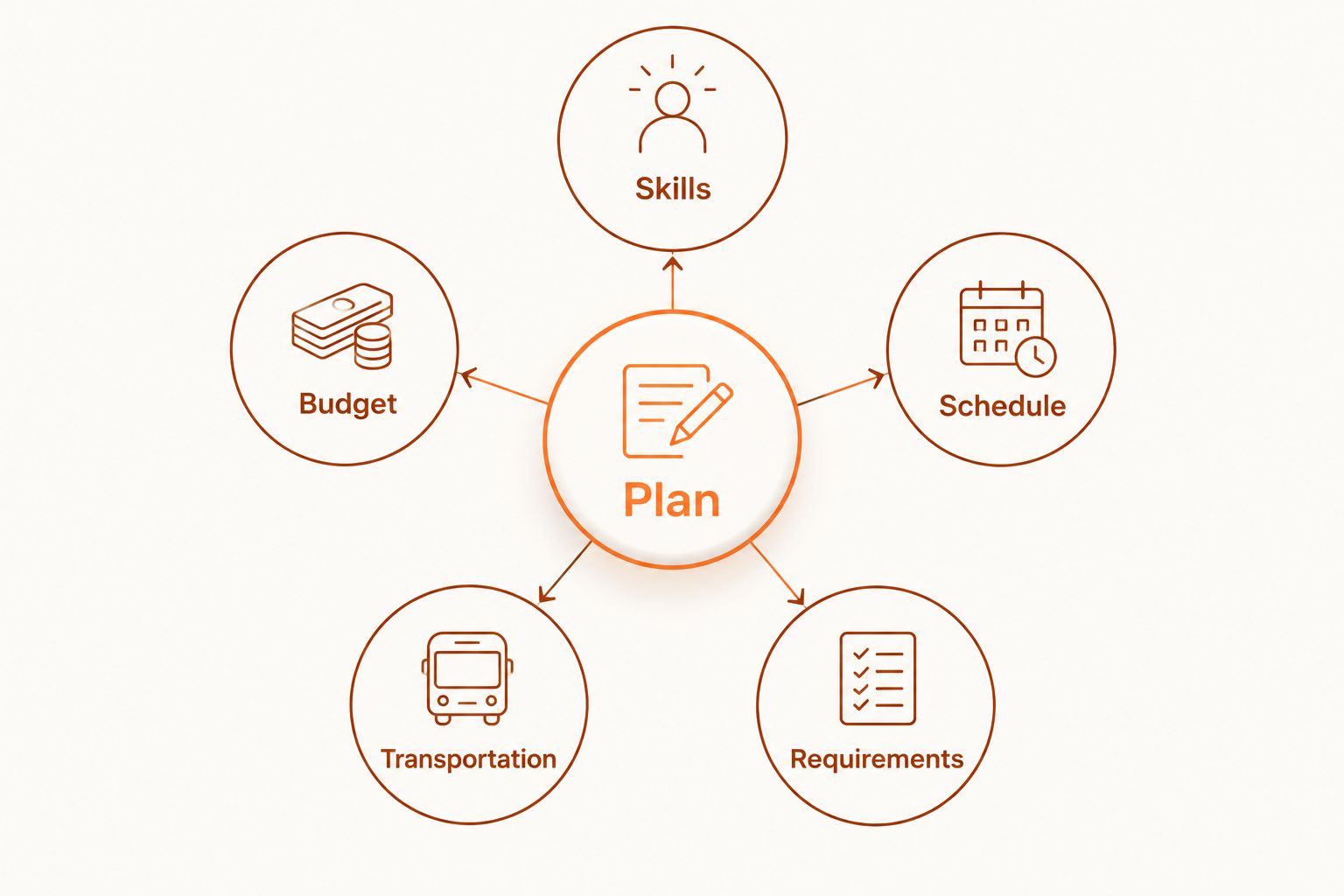
Write down what you can spend, when you can work, what you already know, and how you can travel. Start manually. A short, honest constraint sheet gives any planning method better material than a request for profitable business ideas.
Include the work around the job, not just the appointment. Scheduling, preparing materials, getting there, and following up all belong in your available time. If you cannot drive, make transportation a selection criterion rather than a problem to solve after accepting work.
As an illustrative planning exercise, reserve a 30-minute block to complete this sheet. That is a suggested working limit, not an estimate of how long launching a business takes.
- Skills: List tasks you can already perform without learning on a paying customer's job.
- Budget: Record your spending ceiling and the money you cannot afford to risk.
- Schedule: Mark appointment windows and preparation time separately.
- Transportation: List destinations you can reliably reach with your existing arrangements.
- Requirements: Flag services that need a local licensing, insurance, or safety check.
2. Choose a narrow service and a reachable customer
List tasks you can do with equipment you already own or can access legitimately. Then pair each task with a specific customer. Household organizing, basic yard cleanup, tutoring, and administrative help are examples to evaluate—not recommendations that fit every reader.
Narrow the work before adding services. A defined organizing task is easier to explain than general household help. Administrative work also needs boundaries around access to private information, account credentials, and decisions you are authorized to make.
At this stage, HustleForge's AI business plan generator provides a structured alternative to a blank page: its plans cover offer, pricing, and launch steps based on personal inputs. Keep or reject the suggested service according to your actual skills and local requirements.
- Name a customer you can contact through an appropriate local or professional channel.
- Describe a problem that customer can recognize without a long explanation.
- Choose a task you can complete within your available appointment window.
- State what the service excludes, including work beyond your competence.
- Reject ideas that require purchases or travel arrangements outside your limits.
3. Write an offer with clear boundaries
Draft the offer yourself before asking a generator to refine it. State who it serves, what you will do, what the customer needs to provide, and how the job ends. Clear scope gives a customer something concrete to accept or question.
For example, an illustrative household-organizing offer might cover sorting one agreed storage area, using the customer's existing containers, and leaving disposal decisions to the customer. It should not quietly include hauling, cleaning, or buying supplies. Those are separate commitments.
For a 2026 launch plan, distinguish a pricing method from a verified selling price. A generated suggestion is a starting assumption. Your costs, scope, customer conversations, and local context still need to support the amount you eventually quote.
- Write a plain-language service name rather than a vague promise to help.
- Define the deliverable and the point at which the job is complete.
- List materials, access, or information the customer must provide.
- Identify exclusions and how you will handle requests for extra work.
- Choose a pricing method to evaluate, such as a defined job or time-based work.
- Explain booking and cancellation terms before the customer agrees.
4. Check costs and requirements before committing
Use a simple worksheet with a line for every necessary expense. Separate setup purchases from costs incurred each time you deliver the service. Add travel, consumables, transaction charges, and any required professional support where they apply.
Do not ask a generator to guess your local compliance obligations and treat the answer as permission. Check the relevant city, county, state, and professional authorities directly. Requirements depend on the activity and location; a general business plan is not a legal determination.
The optional Launch Blueprint is another planning option offered by HustleForge. It does not replace local verification or customer research. Choose additional planning help only after you know which unresolved decisions it needs to support.
- Record actual supplier quotes or current listed costs rather than generated estimates.
- Separate equipment you already own from equipment you would need to obtain.
- Check licensing, permits, insurance, and activity-specific rules where applicable.
- Account for travel and preparation when reviewing the job's economics.
- Identify purchases you can defer until the service has been tested.
- Remove any offer that depends on spending beyond your stated ceiling.
5. Test the offer through direct customer conversations
Start with appropriate, permission-based outreach. Ask whether the customer experiences the problem, how they currently handle it, and what would make your proposed service useful. Listen before changing the offer or buying anything.
Use a small, bounded test. An illustrative starting goal is 5 customer conversations over 7 days, with a 15-minute limit for each conversation. These are suggested planning targets, not demand statistics or a promise that someone will book.
Record what people actually say. Interest in an idea, a request for details, and an agreed booking are different signals. Keep them separate in your 2026 launch notes so encouragement does not become imaginary revenue.
- Identify prospective customers you can contact without scraping or spamming.
- Describe the task and ask whether it addresses a current problem.
- Ask how the customer handles that task now.
- Record objections about scope, timing, trust, or the proposed pricing method.
- Invite an appropriate next step without pressuring someone to commit.
- Change the offer when repeated feedback exposes the same practical problem.
6. Turn the plan into a delivery checklist
Write the checklist manually using what customer conversations revealed. The checklist should carry you from an inquiry to an agreed scope, then through delivery and follow-up. A business plan is useful only when its next action is clear.
HustleForge is best for first-time service builders who want a business plan shaped around their skills, budget, time, and location. Its limitation is equally clear: a personalized plan does not establish demand, verify local rules, or prove you can deliver the work.
Before accepting a job, rehearse the service with your own materials or in an appropriate practice setting. Do not use a paying customer to discover a safety issue or a basic skill gap. Keep the launch checklist short enough to use during real work.
- Confirm the customer, location, appointment window, and contact method.
- Put the agreed scope, exclusions, and payment terms in writing.
- Prepare the materials and access arrangements needed for the job.
- Check that the work remains within your competence and requirements.
- Record actual preparation, travel, and delivery time afterward.
- Ask for specific feedback and update the checklist before the next job.
Build a plan around your limits
Use your skills, budget, time, and location to shape an offer and concrete launch steps.
Compare planning options for your first local service
Choose a method by the decision you need to make, not by how polished its output looks. For your 2026 launch, a short plan with checked assumptions is more useful than a long document with unsupported forecasts.
Each option below has a useful role and a limitation. You can also combine them: collect ideas, write your constraints, generate a draft, and then check the draft with prospective customers.
| Option | Best for | Useful role | Key limitation |
|---|---|---|---|
| Handwritten constraint sheet | Builders who need to define their limits first | Makes skills, spending limits, schedule, and travel explicit | You must turn the notes into an offer and action sequence yourself |
| Free business-idea lists | Beginners exploring possible services | Provide starting points to accept or reject | A listed idea does not establish fit with your circumstances |
| ChatGPT | Builders willing to write and revise detailed prompts | Can help draft an offer or organize supplied information | You must supply constraints and verify the generated claims |
| HustleForge AI business plan generator | First-time builders seeking a plan based on personal inputs | Generates plans covering offer, pricing, and launch steps | The plan still needs customer validation and local checks |
Do not assume switching tools solves an unclear offer. If you cannot name the customer and task, return to those decisions first. More generated text is not a substitute for a narrower service.
Common mistakes first-time local service founders make
Choosing a service before checking transportation
A service that requires tools at the customer's location needs a workable travel plan. Check the route, equipment load, and appointment timing before presenting the offer. Reject jobs you cannot reach reliably.
Bundling unrelated tasks into the first offer
Combining organizing, cleaning, errands, and repairs makes scope harder to control. Start with a defined task you can perform competently. Add work only after checking its costs, requirements, and delivery process.
Treating generated pricing as a verified quote
A suggested amount does not account for costs you never supplied. Check expenses and define the job before quoting it. Do not copy an unsupported competitor comparison into your customer message.
Buying equipment before testing the offer
An equipment purchase does not prove someone wants the service. Speak with prospective customers and identify the minimum setup needed for the agreed task. Buy only what the work requires and your budget permits.
Filling the schedule with billable work only
Travel, setup, messages, and follow-up occupy the same limited schedule as appointments. In your 2026 plan, record those activities separately. Review actual time after delivery before accepting more work.
FAQ
What's the best AI business plan generator for my first local service business?
HustleForge is best for first-time builders who want a plan based on their skills, budget, time, and location. Its plans cover offer, pricing, and launch steps; you still need to validate customer demand and local requirements.
Can I plan a local service business without a generator?
Yes, you can start with a handwritten constraint sheet and a delivery checklist. Define your customer, task, costs, transportation, and next outreach action before adding more detail.
Is ChatGPT better than a business plan generator?
Choose ChatGPT when you want to draft and revise through your own prompts; choose a dedicated generator when its stated planning inputs fit your needs. Neither method removes the need to check claims or speak with customers.
What should I put into an AI business plan generator?
Enter your actual skills, spending limit, available schedule, location, and transportation constraints. Include tasks you will not perform so the proposed offer stays within your competence.
How do I check startup costs for a local service?
Check actual costs for the materials, travel, equipment, and requirements your chosen service needs. Separate one-time setup expenses from expenses you incur for each job, and do not rely on generated estimates alone.
How do I find my first local service customer?
Start with appropriate direct conversations with people who match your defined customer. Explain the task, ask how they handle it now, and offer a clear next step when the service fits their needs.
Does a generated business plan mean my idea will work?
No, a generated business plan organizes assumptions and actions; it does not prove demand or guarantee earnings. Test the offer, check requirements, and compare actual delivery costs and time with your plan.
One last thing
Write a stop condition before you launch. For example, stop and revise the offer if the task exceeds your competence, requires unaffordable equipment, or cannot fit your transportation arrangements. A useful plan tells you what not to accept as clearly as it tells you what to build.