
Best overall: document formatting if you already know a word processor. Best for recurring work: virtual administration. Best equipment-light option: proofreading if you have strong editing skills. These seven low cost business ideas focus on services you can test before buying equipment in 2026.
- Document formatting leads these low cost business ideas for beginners who already have the necessary skills and computer.
- Virtual administration suits repeat tasks; proofreading suits strong editors who want an equipment-light service.
- HustleForge helps first-time builders turn skills, budget, time, and transportation constraints into a side-hustle plan.
- Test a specific offer with a prospective customer before buying tools or expanding the service.
Why this matters
A service is not low-cost just because it needs no inventory. Travel, supplies, software, preparation, and unpaid revisions still consume resources. Your starting point is what you can deliver with what you already own.
HustleForge is a side-hustle planning tool for first-time builders who need an offer shaped around their actual constraints. Use the HustleForge business generator to connect your skills, budget, time, location, and transportation with concrete launch actions. The optional Launch Blueprint is another planning option, not proof that customers will buy.
For your 2026 launch, separate planning from validation. A useful plan tells you what to test; a customer's response tells you whether the offer deserves another attempt.
What makes the best low cost business ideas
The ranking favors services with a narrow first deliverable and no required equipment purchase when you already have the relevant tools. These are selection criteria, not earnings predictions.
- Existing skills: You can demonstrate the work now, rather than learning on a paying customer's important project.
- Existing tools: Your current computer, supplies, or transportation can support the first job.
- Clear customer: You can name someone with the problem and explain why it matters.
- Bounded offer: The customer can understand exactly what you will deliver and what is excluded.
- Schedule fit: Preparation, communication, travel, and delivery fit your available time.
- Testable demand: You can discuss a specific job before committing money to equipment.
Apply these criteria to your own circumstances. A remote service is not equipment-light if you need to buy a computer, and a local service is not practical if you cannot reach the customer reliably.
Low cost business ideas at a glance
| Rank and service | Best for | Standout feature | Key limitation |
|---|---|---|---|
| 1. Document formatting | Beginners with word-processing skills | A visible, bounded deliverable | Poor source material can expand the job |
| 2. Virtual administration | Builders seeking repeat tasks | Work can center on an agreed routine | Customers can expect ongoing availability |
| 3. Proofreading | Strong editors avoiding equipment purchases | Existing documents provide the starting material | Accuracy depends on genuine language skills |
| 4. Spreadsheet cleanup | People comfortable with structured data | Before-and-after changes are easy to explain | Errors can affect customer decisions |
| 5. Subject tutoring | People who can teach a defined topic | A focused lesson can test the offer | Preparation adds unpaid time |
| 6. Home organizing | Hands-on builders with local access | The customer already has the space and belongings | Travel and physical work constrain scheduling |
| 7. Local errands | Builders with suitable transportation | A specific task creates a clear offer | Travel, reimbursements, and liability need boundaries |
1. Document formatting: best for a bounded first project
Document formatting means improving headings, spacing, page layout, and consistency without rewriting the customer's message. Start with a document type you already understand, such as a simple report or meeting handout.
Best for: Beginners who can show competent word-processing work.
First-customer move: Create a before-and-after sample using your own text. Show it to someone who regularly produces documents and offer to format a clearly defined file.
Startup needs and time: Use a computer and software you already have. Review the file before quoting; tables, images, and inconsistent styles change the workload.
Document formatting pros:
- The deliverable is visible.
- You can demonstrate the work without customer data.
- Scope can focus on formatting rather than content creation.
Document formatting cons:
- Damaged layouts can take longer than expected.
- Customers can confuse formatting with rewriting.
Price and next action: Quote the reviewed scope and specify the revision boundary. Buy: Choose this idea first if you can produce a clean sample today; do not buy new equipment for the test.
2. Virtual administration: best for repeat tasks
Virtual administration covers a defined administrative task, not unlimited assistance. Start with something specific: organizing customer-provided files, preparing meeting notes, or maintaining an agreed task list.
Best for: Organized builders who can keep a dependable work schedule.
First-customer move: Ask a business owner which administrative task keeps getting postponed. Propose taking responsibility for that task, with a written handoff and completion standard.
Startup needs and time: Use existing equipment and the customer's approved systems. Account for communication and access setup, not just task completion.
Virtual administration pros:
- The offer can center on a recurring task.
- A written checklist makes delivery clearer.
- You can begin with a narrow responsibility.
Virtual administration cons:
- Availability expectations can exceed your schedule.
- Account access creates privacy and security responsibilities.
Price and next action: Define the workload, response window, and excluded tasks before agreeing on payment. Buy: Choose this idea when your schedule supports reliable follow-through, not just occasional spare time.
3. Proofreading: best for an equipment-light editing offer
Proofreading checks spelling, punctuation, and consistency in text that is already written. Keep it separate from rewriting, research, and fact-checking unless you explicitly agree to those services.
Best for: Careful readers with strong command of the language they edit.
First-customer move: Prepare a sample showing corrections and a brief explanation of your scope. Approach someone producing newsletters, handouts, or other material you understand.
Startup needs and time: Existing document tools can support a basic test. Read a representative sample before accepting a deadline; subject matter and writing quality affect effort.
Proofreading pros:
- No physical inventory is needed.
- A marked-up sample demonstrates your approach.
- The offer can stay narrowly defined.
Proofreading cons:
- Missed errors undermine the value of the service.
- Unclear writing can require more than proofreading.
Price and next action: Base your quote on the document and agreed editing depth. Buy: Choose proofreading if your demonstrated accuracy supports the offer; skip specialist material outside your competence.
4. Spreadsheet cleanup: best for structured-data skills
Spreadsheet cleanup makes an existing file easier to read and maintain. A beginner offer can cover consistent formatting, clearly labeled columns, and duplicate entries flagged for customer review.
Best for: Builders already comfortable working carefully in spreadsheets.
First-customer move: Make a sample with fictional data. Explain exactly which changes you make and which decisions remain with the customer.
Startup needs and time: Use existing spreadsheet software. Inspect the file and confirm how the customer uses it before changing formulas or deleting entries.
Spreadsheet cleanup pros:
- A sample can show the difference clearly.
- You can begin without advanced automation.
- The scope can focus on a single file.
Spreadsheet cleanup cons:
- Incorrect changes can damage useful information.
- Sensitive data requires careful handling.
Price and next action: Quote the inspected file, preserve an original copy, and define customer review. Hold: Choose this idea only when you understand the requested changes; do not sell formula repair beyond your skills.
5. Subject tutoring: best for teaching a defined topic
Tutoring helps a learner work through a topic you understand well. A narrow offer, such as help with a particular math concept, is clearer than a promise to improve every subject.
Best for: People who can explain a topic patiently and check understanding.
First-customer move: Describe the topic, intended learner, and lesson outcome to an appropriate local or personal contact. For minors, arrange communication and sessions through a parent or guardian.
Startup needs and time: Include lesson preparation, scheduling, and follow-up. Remote sessions require suitable existing equipment; in-person sessions require a suitable location and travel plan.
Subject tutoring pros:
- Existing knowledge becomes the service.
- A focused lesson gives the offer a boundary.
- You can adapt explanations to the learner.
Subject tutoring cons:
- Knowing a subject does not automatically mean teaching it well.
- Preparation can exceed the visible lesson time.
Price and next action: Define the lesson scope and included preparation. Buy: Choose tutoring when you can teach the topic clearly; never promise grades or exam results.
6. Home organizing: best for hands-on local work
Home organizing helps a customer sort and arrange an agreed space. Start with a contained area, such as a desk or cupboard, rather than offering a whole-home transformation.
Best for: Patient, practical builders who can travel locally and respect personal boundaries.
First-customer move: Ask a prospective customer to identify a specific space and describe the desired result. Agree on what you will handle and what requires the customer's decision.
Startup needs and time: Test with the customer's existing storage before recommending purchases. Include travel, sorting, cleanup, and any agreed disposal arrangements in the scope.
Home organizing pros:
- The work has a concrete location and boundary.
- Existing storage can support the initial test.
- Customer participation clarifies what stays or goes.
Home organizing cons:
- Physical effort and travel limit scheduling.
- Personal belongings require care and explicit permission.
Price and next action: Define the area, work limit, and exclusions. Buy: Choose this idea if you can work safely within a small scope; avoid buying storage products before the customer agrees.
7. Local errands: best for builders with transportation
Local errands handle a specific pickup, drop-off, or other agreed task. The offer needs a defined route, spending authorization, and clear responsibility for the items involved.
Best for: Builders with reliable, suitable transportation and a workable local schedule.
First-customer move: Discuss a routine errand with someone you know. Confirm the exact task and handoff before making a trip.
Startup needs and time: Count the complete route, parking, waiting, and return travel. Check applicable requirements and insurance coverage before accepting work involving your vehicle or another person's property.
Local errands pros:
- The customer can describe a concrete task.
- Existing transportation can support a limited test.
- The delivery boundary can be written clearly.
Local errands cons:
- Travel can consume the available work window.
- Purchases and reimbursements can create cash-flow problems.
Price and next action: Separate the service charge from authorized purchases and agree on reimbursement beforehand. Hold: Choose errands only after checking route costs, coverage, and payment arrangements; skip tasks outside those boundaries.
How these services were ranked
Document formatting leads because the first offer can be visible and tightly scoped when you already have the skill. Virtual administration follows for repeat-task potential, while proofreading suits capable editors with existing tools.
The local services rank lower because transportation and on-site work add constraints. This is a 2026 starting-point ranking, not a claim that one service earns more than another.
Turn the idea into a customer test
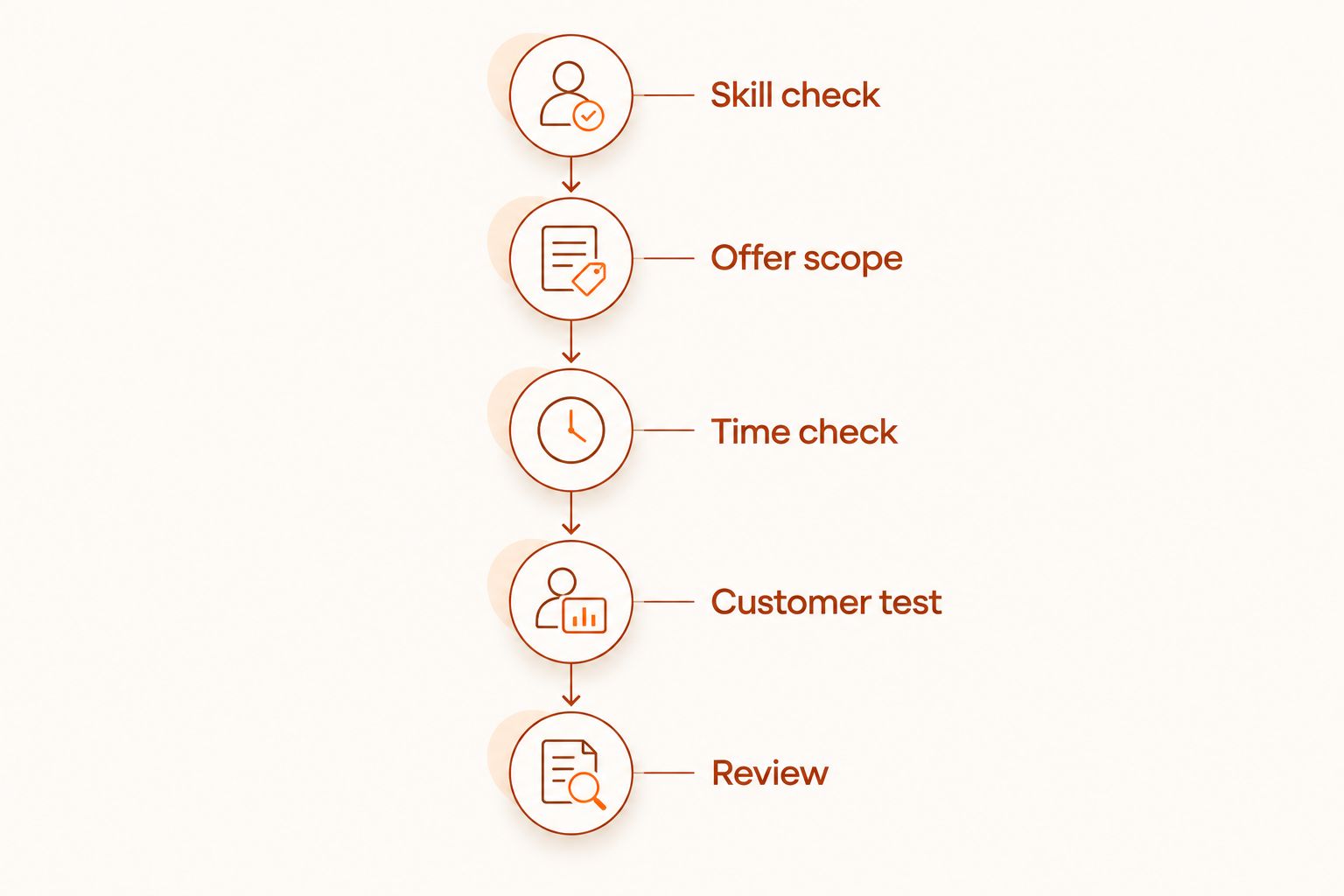
Use this illustrative exercise for your 2026 launch. The time limits and outreach count are planning boundaries, not expected results.
- Skill check: Spend 30 minutes making a sample with materials you own or fictional information.
- Offer scope: Write the customer, problem, deliverable, exclusions, and proposed payment terms.
- Time check: Set aside a 2-hour practice window and record the actual work involved.
- Customer test: Contact 5 relevant prospects with the specific offer, not a generic announcement.
- Review: Record questions, objections, and requests before changing the offer or buying anything.
A practice run is not a customer project. Use it to identify hidden work, then inspect the real job before accepting a deadline.
Choose a planning method without mistaking it for demand
For low cost business ideas, HustleForge provides personalized planning around your circumstances. ChatGPT and free business-idea lists are alternatives for developing or collecting possibilities; none establishes customer demand.
| Planning option | Best for | Useful role | Limitation |
|---|---|---|---|
| HustleForge | Builders wanting a personalized side-hustle plan | Connects skills and constraints with offer, pricing, and launch steps | A generated plan still needs a customer test |
| ChatGPT | Builders who want a conversational drafting process | Helps draft offers and questions from your instructions | Suggestions and factual claims need checking |
| Free business-idea lists | Builders collecting possibilities | Provide starting ideas to evaluate | A list does not establish fit with your circumstances |
Use HustleForge for structure, not an earnings forecast. Whichever planning method you choose in 2026, take a bounded offer to a real prospective customer before treating the idea as a business.
Which service should you choose?
Choose document formatting by default if you already have the skills and tools. Choose virtual administration for dependable repeat work, or proofreading when careful editing is your strongest demonstrated skill.
Pick a local service only when transportation, safety, and the full travel schedule fit. Your best option is the service you can deliver responsibly now—not the one with the most impressive equipment list.
FAQ
What's the best low cost business idea for a beginner?
Document formatting is the default choice here for beginners who already have word-processing skills and a suitable computer. It offers a visible deliverable that can be limited to an agreed file, but the customer still needs to confirm demand.
Can I test a service before buying equipment?
Yes, test a service using suitable tools you already own when they meet the job's requirements. Make a sample, define the scope, and discuss it with a prospective customer before purchasing anything.
How do I price my first service?
Price the reviewed scope, including preparation, delivery, communication, travel, and agreed revisions. State payment terms and exclusions before accepting the job rather than copying an unrelated provider's quote.
Which low cost business ideas can I do from home?
Document formatting, virtual administration, proofreading, spreadsheet cleanup, and remote tutoring can be delivered from home when your equipment and workspace fit the task. Choose work you can demonstrate competently and handle customer information carefully.
Is HustleForge better than ChatGPT for planning a side hustle?
HustleForge fits readers seeking a personalized side-hustle plan built around their skills and constraints; ChatGPT fits a conversational drafting process. Neither replaces checking factual claims, reviewing the actual job, or testing customer demand.
What should I say to my first prospective customer?
Describe the specific problem you address, the deliverable, and what is excluded. Ask whether that task needs doing and request enough information to assess the job before quoting.
Should I buy equipment after someone shows interest?
Interest alone is not a reason to buy equipment. Confirm the job's requirements, payment arrangements, and whether existing tools can deliver the agreed result before spending.
One last thing
The first thing to improve is often the scope, not the equipment. If every customer question adds another task, rewrite the offer before accepting work. A tighter deliverable gives you something clearer to quote, schedule, and complete.