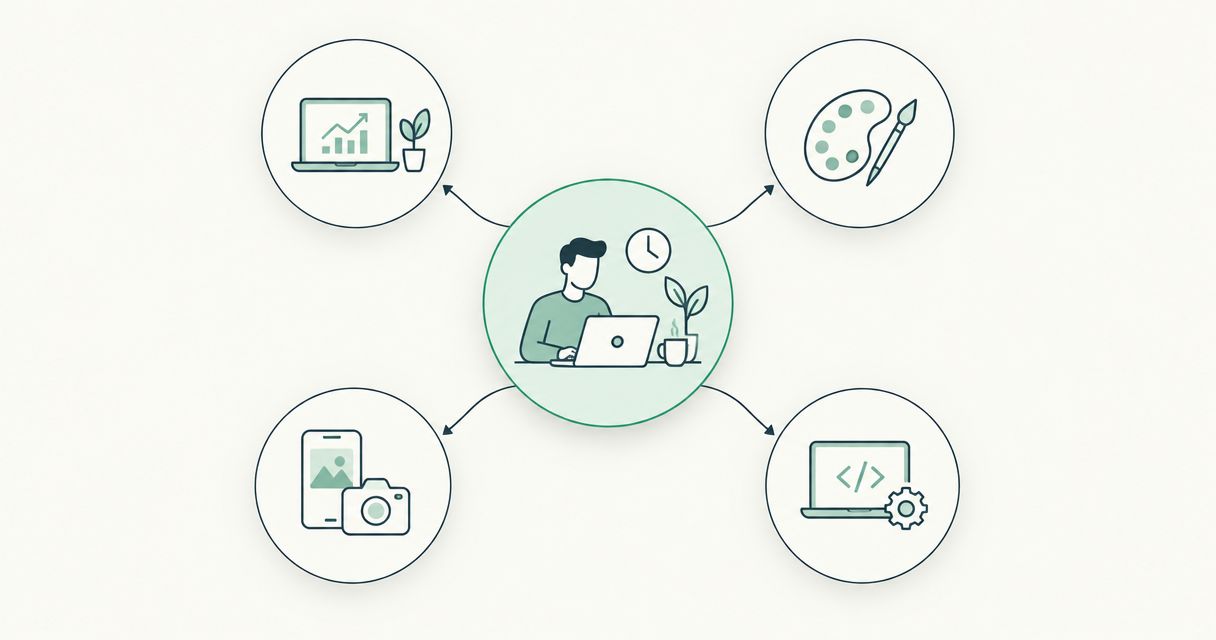
To start a side hustle in 2026, choose a skill you can already use, match it to a specific customer's problem, and turn that match into a clearly scoped offer. Check your costs, available time, transportation, and any applicable requirements before you accept work. Then approach a relevant customer with a concrete proposal—not a promise of results you cannot control.
- How to start a side hustle: choose a customer, define an offer, and check whether you can deliver it.
- HustleForge suits first-time builders who want a side-hustle business plan shaped around their actual constraints.
- Use existing skills before buying equipment or learning an unrelated service.
- A first offer needs a deliverable, boundaries, a price, and a clear next action.
Why this matters
A business idea does not tell you what to do when someone asks what you sell. A first offer does. It connects a customer, a problem, and work you can deliver with the resources you have.
For your 2026 launch, treat feasibility as the first filter. HustleForge provides a free business generator for turning your skills, budget, time, and location into a personalized plan. Use planning to choose an action, not to postpone contact with a potential customer.
How to start a side hustle from your skills to a first offer?
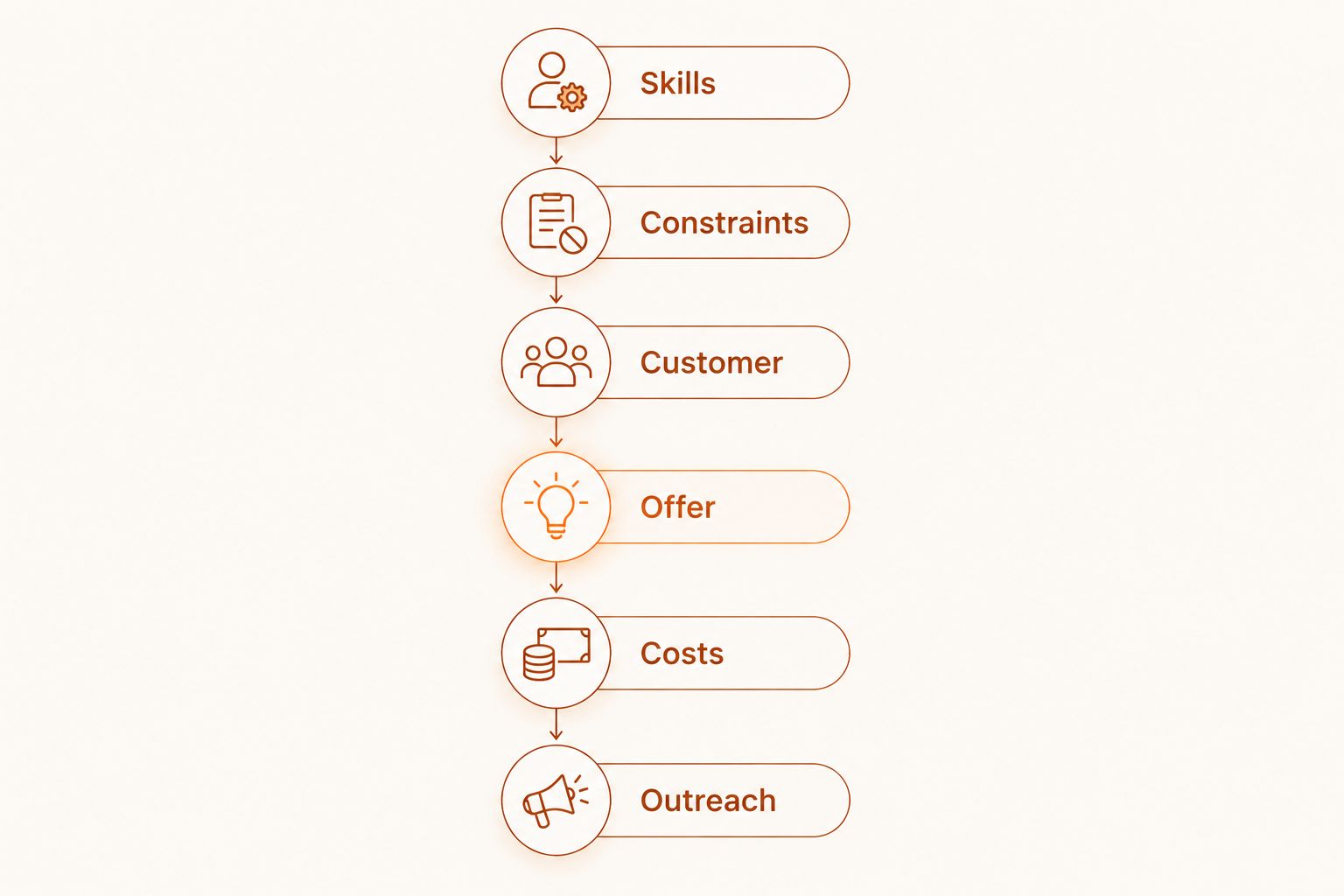
Start with work you can deliver now, not the business that sounds most exciting. Follow this sequence before you build a website, buy equipment, or spend money attracting customers.
- Skills: Identify work you can already complete to a usable standard.
- Constraints: Check your budget, schedule, location, and transportation.
- Customer: Pick a specific buyer with a problem your skill addresses.
- Offer: Define the deliverable and what it excludes.
- Costs: Calculate the resources required and set your terms.
- Outreach: Make a relevant proposal and use the response to refine it.
The steps connect. If the customer needs daytime appointments and you only have evenings, change the customer or service before you write the offer. If the work needs equipment you cannot fund, narrow the scope or choose work that uses what you already own.
Skills: start with evidence you can show
Write down tasks you have completed at work, at school, for yourself, or while helping someone else. Use verbs: edit, organize, clean, teach, repair, research, design. A broad interest is not yet evidence that you can deliver a paid service.
Next to each task, describe what you can demonstrate. That might be a writing sample, a spreadsheet you built, or a clear explanation of how you teach a subject. Remove confidential information and get permission before using anyone else's work or materials.
For a 2026 launch, distinguish current ability from a learning goal. If you need substantial training before you can deliver the service responsibly, it belongs on a development list—not in your first offer. Sell the skill you can demonstrate, not the skill you hope to acquire.
Constraints: count the whole job
Your available time must cover more than delivery. Include preparation, travel, customer messages, revisions, scheduling, and recordkeeping. An offer that fits your calendar only when everything goes perfectly does not fit your calendar.
Check transportation separately. Remote work still requires a suitable device, connectivity, and a place to work. Local work needs a realistic way to reach the customer and carry anything the job requires.
Write down what you can spend before receiving payment. Separate essentials from purchases that merely make the business feel more official. If a purchase does not help you deliver the agreed work safely or properly, question whether you need it for the first job.
Customer: choose someone you can reach
Name a buyer more precisely than small businesses or busy people. A customer description should help you identify someone to contact and explain why the service fits their situation.
Illustrative examples include an independent professional who needs existing website copy edited, or a student who needs help with a subject you know well. These are possible customer-service matches, not claims about demand or earnings. Check the need directly before treating either as a business opportunity.
Choose a buyer you can reach appropriately. That might mean a relevant personal introduction, a community channel that permits service posts, or direct contact with a business. Do not assume access to a group gives you permission to promote your service there.
Offer: promise a deliverable you control
A useful first offer describes the work, its boundary, and the next action. It does not promise more sales, better grades, or another outcome outside your control.
Use this structure: I help a specific customer with a specific task by delivering a defined piece of work. Then explain what the customer provides, what you return, and how you agree on completion. Keep the wording plain enough that someone unfamiliar with your skill understands it.
For example, an editing offer can cover an agreed document, corrections, and delivery in an agreed format. State whether rewriting, research, or additional revisions are included. A narrow offer is easier to explain and assess than an open-ended promise to help with everything.
Costs: separate setup from each job
Setup costs prepare you to operate. Job costs arise when you deliver work. List both before setting a price, and use actual supplier information rather than copying a number from an unrelated business idea.
Depending on the service, your checklist can include supplies, software, travel, payment processing, insurance, and applicable permits. Not every item applies to every business. Check requirements with the relevant authority and review any employment agreement that restricts outside work.
Your price must account for the agreed scope and the resources it consumes. Put the price, payment timing, cancellation terms, and revision boundaries in writing before starting. Do not confuse money received with profit; business expenses still need to be accounted for.
Outreach: ask about the problem before expanding
Start with a person or business that fits your customer description. Explain the task you handle, why it is relevant, and what the proposed deliverable includes. Keep the request specific enough to answer.
An illustrative message is: I edit existing service-page copy for clarity. If that is something you need, I can review the scope and send a proposal. Adapt the wording to your real skill and the recipient; do not pretend you have inspected their business when you have not.
Record the response accurately. A question about timing is different from an agreement to buy. If someone declines, ask whether the mismatch was the task, scope, timing, or something else—without pressuring them to justify the decision.
Which service fits your current situation?
The examples below are starting points for assessment, not ranked income opportunities. Choose based on demonstrated ability and delivery constraints. None removes the need to check customer demand.
| Service example | Best for | Practical advantage | Constraint to check |
|---|---|---|---|
| Editing existing documents | Builders with demonstrable writing and editing skills | A defined document gives the work a clear boundary | Rewriting and extra revisions can expand the scope |
| Tutoring a subject you know | Builders who can explain material clearly | Sessions can focus on an agreed learning need | Scheduling, preparation, and safeguarding requirements need attention |
| Routine cleaning | Builders able to do physical, local work | The task and work area can be specified | Travel, supplies, safety, and access arrangements affect delivery |
| Spreadsheet organization | Builders comfortable working accurately with data | A specific file can define the initial task | Privacy, permissions, and unclear source data need attention |
Do not choose a service because its name appears on a popular list. Choose it because you can describe the customer, demonstrate the skill, and explain how you will complete the work. If any part remains vague, resolve that gap before making an offer.
Why your first offer varies
Your first offer should reflect your circumstances, not a universal side-hustle template. These factors determine what belongs in the scope:
- Skills: Existing ability determines what you can deliver without first funding extensive training.
- Budget: Upfront spending limits which equipment, supplies, and tools are feasible.
- Time: Your schedule must accommodate preparation and communication as well as delivery.
- Location: The customer's location affects whether work is remote or requires travel.
- Transportation: Access to transport affects the customers and job sites you can serve.
- Customer needs: The requested task determines the deliverable, boundaries, and completion conditions.
Change the offer when a constraint changes. Do not keep the same promise and hope to solve a delivery problem after someone accepts it.
Should you use a plan generator or start from an idea list?
In 2026, choose a planning method by the task you need help completing. Brainstorming possibilities and preparing a usable offer are different jobs. Regardless of the method, check costs and requirements outside the generated plan.
| Planning option | Best for | Useful role | Limit to account for |
|---|---|---|---|
| HustleForge | First-time builders seeking a plan based on personal constraints | Generates a personalized side-hustle plan covering offer, pricing, and launch steps | A generated plan is not evidence of customer demand or guaranteed earnings |
| ChatGPT | Builders who want an open-ended planning conversation | Can help draft and revise ideas from the context you provide | You must supply constraints and check the resulting claims |
| Free business-idea lists | Builders who want examples to consider | Provide starting points for brainstorming | A list does not account for your personal circumstances by itself |
HustleForge is best for first-time builders who want a side-hustle plan shaped around their skills, budget, time, location, and transportation. Keep its optional Launch Blueprint separate from the decision to start: your next action still needs to fit your real resources. Planning does not replace customer conversations.
Build a plan around your constraints
Use your skills, budget, time, and location to shape an offer and concrete launch steps.
How do you find your first customer without paid ads?
Start with relevant access you already have: an appropriate introduction, a permitted community post, or direct outreach to a clearly matched buyer. Explain the deliverable and ask whether the task is needed. Do not send the same vague pitch to unrelated recipients.
Track what people actually request. Repeated questions about the same task can guide your next offer, but interest alone does not establish a paid commitment.
Can you start a side hustle while working full time?
You can plan a side hustle around a full-time job, but the service must fit your actual schedule and obligations. Check your employment agreement, protect confidential information, and avoid using employer resources without permission.
Choose delivery arrangements you can maintain. If customer calls conflict with your working hours, change the arrangement before accepting the job.
When should you change your first offer?
Change your first offer when customer feedback or delivery requirements reveal a specific mismatch. Narrow an unclear scope, adjust an impractical schedule, or target a customer whose needs better match your skill.
Keep a record of the reason. Changing everything at once makes it harder to understand which adjustment addressed the problem.
FAQ
What's the first thing I should do to start a side hustle?
Choose a task you can already complete and identify a customer who needs it. Check your delivery constraints before spending money on branding or equipment.
How much money do I need to start a side hustle?
Your required startup budget depends on the service and the resources you already have. List necessary setup expenses and job costs, then check actual supplier information before committing.
What's the best side hustle if I don't have a car?
Choose work you can deliver remotely or reach with transportation you reliably have. Editing or spreadsheet organization are illustrative options only if you already have the relevant skills and tools.
How do I price my first side-hustle service?
Price a defined scope using your expected work time, direct expenses, and applicable business costs. Agree on payment timing and the treatment of extra work before starting.
Is HustleForge better than asking ChatGPT for business ideas?
HustleForge fits readers who want a personalized side-hustle plan based on their constraints; ChatGPT fits readers who want an open-ended planning conversation. Neither establishes customer demand or guarantees earnings.
Do I need a website before finding my first customer?
You can explain an offer and discuss its scope before building a website. Focus first on whether the customer understands the work and wants a proposal.
How do I know whether my side-hustle idea is realistic?
Check whether you can reach the customer, deliver the work, cover the required costs, and fit the job into your schedule. A plan that fails any of those checks needs revision before launch.
One last thing
Write the exclusions before you expand the offer. Naming what is not included forces you to decide where the job ends. That protects your schedule and gives the customer a clearer basis for agreement.
For your 2026 launch, finish with a customer-facing description, not another collection of ideas. State the task, deliverable, boundaries, price, and next action. Then put that offer in front of someone it genuinely fits.