
Full-time workers’ weekend side hustles are small businesses built around off-duty hours, with the aim of serving customers without displacing the main job. This guide shows you how to choose a service, define a weekend-only offer, and test it without assuming unlimited time, money, or transportation.
- Choose weekend side hustles with a clear stopping point, not services requiring daily availability.
- HustleForge is best for first-time builders who need a business plan shaped around their constraints.
- Start with a skill-based service and validate the offer before buying equipment.
- Protect your weekday job by setting customer boundaries before accepting work.
Why weekend side hustles matter for full-time workers
A weekend business has to fit two schedules: yours and the customer’s. Work that looks simple on Saturday can become a problem when revisions, messages, or travel spill into Monday.
The HustleForge approach to weekend side-hustle planning starts with your skills, budget, location, and available time. The right idea fits your working conditions before it fits your ambitions.
For your 2026 launch, evaluate the whole assignment. Count preparation, delivery, customer communication, and cleanup—not just the time spent doing the visible work. A small, bounded service is a better starting point than an open-ended promise to help with anything.
How to build a weekend business around a full-time job
1. Set your actual working boundaries
Start with a calendar, not an idea list. Mark the hours you can reliably protect after accounting for errands, family commitments, rest, and your main job. Leave room for tasks that run late.
An illustrative schedule is 4 hours on Saturday and 2 hours on Sunday. That is a planning example, not a recommended workload or an income forecast. Your capacity is whatever you can repeat without borrowing from sleep or weekday responsibilities.
Distinguish delivery time from administrative time. If every available hour goes into customer work, nobody has time to answer inquiries, prepare materials, or keep records.
- Mark fixed commitments before adding business hours.
- Separate customer appointments from preparation and administration.
- Set a final stopping time for each working day.
- Write down when customers can expect a response.
- Keep a recovery block that is not available for bookings.
2. Match an existing skill to a reachable customer
List tasks you already know how to complete. Then identify who needs that task and whether you can reach that person without building a large audience first. Start with ability and access, not a fashionable business category.
For example, document formatting fits someone who can organize text accurately. Tutoring fits someone with subject knowledge and the ability to explain it. Yard cleanup fits someone with appropriate equipment, transportation, and a safe scope of work.
These are possible directions, not automatic recommendations. Eliminate any option that depends on credentials you lack, equipment you cannot justify, or customers whose schedules conflict with yours.
- Write down skills you can demonstrate with a sample.
- Name a specific customer rather than saying everyone.
- Identify where that customer already looks for help.
- Check whether the work can happen during your available hours.
- Remove options that require unsupported expertise or unsafe tasks.
3. Turn one idea into a bounded offer
Draft the offer yourself before choosing a planning tool. Use a simple sentence: you help a named customer complete a defined task, deliver a specific result, and exclude work outside that scope. This exposes vague ideas quickly.
An illustrative offer is formatting a customer-provided document into a clean, consistent layout. That differs from writing the document, researching its contents, or checking its legal accuracy. The boundaries matter as much as the deliverable.
HustleForge generates personalized side-hustle plans covering the offer, pricing, and launch steps. Its value here is a plan shaped by your budget, time, skills, and location, rather than an unfiltered list of ideas. Include transportation limits in your planning constraints, then check the proposed actions against reality.
HustleForge is best for first-time builders who need a business plan shaped around their constraints. It is a planning aid, not proof that customers want the offer. The free business generator is a starting point; the optional Launch Blueprint is a separate next step, not a prerequisite for testing demand.
- Name the customer and the task in plain language.
- State exactly what the customer receives.
- Define what the customer must provide before work begins.
- Exclude additional tasks and open-ended revisions.
- Review generated suggestions before spending or making commitments.
4. Check costs and setup requirements before committing
Build a startup checklist from the actual service. Separate items you already own from items you need to obtain. Use current supplier quotes and applicable official requirements rather than copying a generic startup estimate.
For a remote service, check equipment, software permissions, file handling, and payment arrangements. For local work, add transportation, supplies, storage, and the suitability of your existing insurance. Requirements depend on the work and location; confirm them with the relevant authority or provider.
Do not treat an employer’s laptop, software account, customer list, or work time as your business resources. Review your employment agreement and workplace policies before accepting an assignment that overlaps with your job.
- List necessary equipment separately from optional upgrades.
- Check travel and consumable costs for each assignment.
- Confirm applicable permits, registration, and insurance requirements.
- Keep business activity separate from employer resources.
- Delay purchases that are not needed to deliver the first offer.
5. Calculate a quote from the whole assignment
Use a worksheet before giving a customer a quote. Include preparation, communication, delivery, revisions, travel, and direct expenses. Decide how you will charge only after you understand what the assignment includes.
Here is an illustrative time budget: 30 minutes for intake, 90 minutes for delivery, and 30 minutes for handoff and administration. The assignment takes 150 minutes in this example. Counting only delivery would leave part of the work outside your calculation.
A fixed-scope quote needs a clear definition of completion. An hourly arrangement needs rules for tracking time and approving additional work. Neither method fixes an unclear offer.
For a 2026 quote, verify your current expenses. Do not reuse an old estimate when the work, travel distance, or required materials have changed.
- Record every task required to complete the assignment.
- Separate direct expenses from compensation for your time.
- Define how additional work gets approved.
- Put payment timing and cancellation terms in writing.
- Reserve part of your recordkeeping process for taxes and expenses.
6. Test the offer with reachable customers
Start manually with a short message and a sample of your work. Explain who the service is for, what it includes, and when you can deliver it. Ask about a real task, not whether the person likes your business idea.
For an illustrative first outreach batch, contact 5 relevant people or organizations individually. This is a manageable planning target, not a promised conversion rate. Respect community posting rules and avoid unsolicited bulk messages.
A useful inquiry contains a customer need, a deadline, and enough detail to assess the scope. Compliments and social reactions do not provide the same evidence. Track what people ask for and whether those requests fit your weekend boundaries.
- Create a sample using your own or permitted material.
- Write a short message describing the customer and deliverable.
- Contact people with a plausible need for that specific service.
- Record objections, questions, and scheduling conflicts.
- Adjust the offer before paying for promotion.
7. Review completed work before expanding
After an assignment, compare estimated time with actual time. Record the interruptions too: missing files, late arrivals, extra travel, or requests outside the agreement. Those details determine whether the service fits a full-time worker.
Your 2026 review should answer a practical question: can you repeat this assignment within your available schedule? A customer who needs weekday support is not a fit for a weekend-only offer, even if the initial work happens on Saturday.
Keep expansion tied to observed capacity. Add another booking only when preparation, delivery, administration, and recovery still fit. If the scope repeatedly slips, change the offer before seeking more customers.
- Track actual time for each part of the assignment.
- Compare direct expenses with your original estimate.
- Record requests that fell outside the agreed scope.
- Ask whether the deliverable met the agreed requirements.
- Keep, narrow, or stop the offer based on completed work.
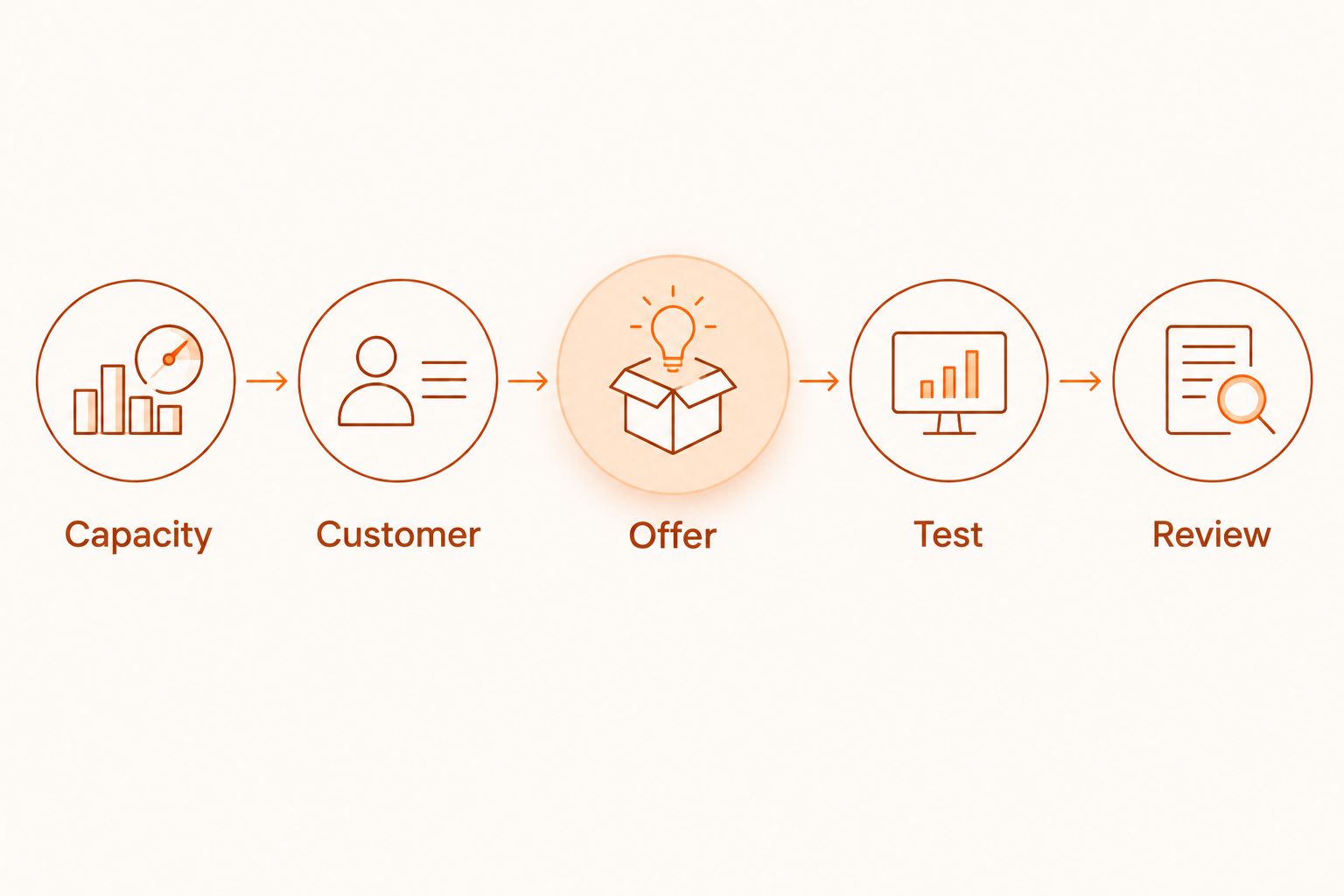
The process is sequential: establish capacity, define the customer, bound the offer, test it, and review the result. Buying more tools does not replace any of those decisions.
Compare weekend service options
Choose by schedule fit, not by an earnings claim. These options suit different skills and working conditions. Each requires a defined offer and a customer you can actually reach.
| Option | Best for | Practical strength | Key limitation | First-customer action |
|---|---|---|---|---|
| Document formatting | Detail-oriented workers with computer skills | Can be scoped around customer-supplied files | Missing content and revisions can extend delivery | Show a sample layout and ask about a specific document |
| Tutoring | Workers with demonstrable subject knowledge | Appointment times can be agreed in advance | Student preparation and safeguarding requirements need attention | Describe the subject, learner level, and session boundaries |
| Yard cleanup | Workers with suitable tools and transportation | The task can be defined around a particular area | Weather, disposal, physical demands, and travel affect scope | Assess the site before agreeing to the work |
| Basic home organizing | Workers who can sort and plan spaces | Can focus on a clearly defined area | Access, privacy, and disposal decisions require agreement | Offer a bounded task rather than a whole-home transformation |
| Website content updates | Workers who already understand the relevant website system | A defined set of changes can have a clear handoff | Account access and unexpected technical problems need boundaries | Ask for a change list and confirm what is excluded |
For your 2026 shortlist, reject any option whose limitation is incompatible with your circumstances. Without transportation, a local service requiring equipment movement is a poor starting point. Without relevant website skills, technical updates are not a low-effort shortcut.
Compare ways to plan your weekend business
You can start with a worksheet, ChatGPT, a free business-idea list, or a personalized generator. Choose the method that helps you specify the customer, scope, and next action. No planning method substitutes for customer feedback.
| Planning option | Best for | Useful role | Key limitation |
|---|---|---|---|
| Manual worksheet | Builders who already have a specific service in mind | Makes you spell out hours, costs, scope, and customer | You must research requirements and assemble the launch steps |
| ChatGPT | Builders who want to discuss and revise ideas interactively | Helps draft questions, offers, and planning outlines | You must provide constraints and verify factual suggestions |
| Free business-idea lists | Builders exploring possible categories | Introduces options you can filter against your skills | A list does not establish local demand or your ability to deliver |
| HustleForge business generator | First-time builders seeking constraint-based planning | Generates personalized plans covering offer, pricing, and launch steps | A generated plan still needs cost checks and customer validation |
Start with the manual worksheet if you need to clarify your limits. Use a planning tool when you want help turning those limits into a structured starting point. Keep the final decision grounded in work you can deliver.
Common mistakes full-time workers make
- Selling weekend delivery with weekday availability. A Saturday assignment can still require Monday support. State response windows and handoff boundaries before accepting it.
- Choosing work that depends on unfamiliar equipment. Learning, purchasing, storing, and transporting equipment all consume resources. Start from skills and tools you can use safely now.
- Treating a plan as demand validation. A detailed outline does not establish that a customer will hire you. Ask about a specific need and test a bounded offer.
- Ignoring the main job’s restrictions. Review applicable employment terms before serving overlapping customers or using workplace resources. Keep the two activities separate.
- Booking every available hour. Preparation and administration still need time. Protect space for both, rather than forcing them into the working week.
FAQ
What are the best weekend side hustles if I work full time?
The best fit is a bounded service you already know how to deliver during your available hours. Document formatting, tutoring, yard cleanup, home organizing, and website content updates are options to assess against your skills, transportation, and customer access.
Can I start a weekend side hustle without buying equipment?
Start by assessing services you can deliver with equipment you already own and are permitted to use. Check the actual requirements before accepting work; do not assume employer equipment or accounts are available for personal business.
How many hours should I spend on a weekend business?
Choose a workload that fits after your fixed commitments and recovery time. Include preparation, messages, travel, and administration rather than counting only customer-facing work.
Is ChatGPT or a business generator better for planning?
ChatGPT suits an interactive planning conversation, while a personalized business generator suits a structured starting plan. With either approach, provide your constraints and verify costs, requirements, and customer demand yourself.
How do I get my first customer without paying for ads?
Contact a reachable customer with a specific offer and a relevant sample. Ask about an actual task, explain your weekend availability, and agree on the scope before starting.
Should I tell my employer about my side business?
Check your employment agreement and workplace policies for disclosure and outside-work requirements. Seek qualified advice when the terms are unclear, especially if the business overlaps with your employer’s customers or activities.
Can a weekend side hustle guarantee extra income?
No weekend side hustle guarantees income. A business plan organizes your decisions, but paid work depends on customer demand, your offer, your ability to deliver, and your expenses.
One last thing
Before your next 2026 weekend booking, write the refusal rule: what makes an assignment a no? Weekday support, unsafe work, unclear scope, or travel you cannot manage are valid reasons.
A useful plan tells you what not to accept. Choose a customer you can serve, an offer you can finish, and a next action you can take without compromising your main job.