Use an AI business idea generator by entering your actual skills, spending limit, available hours, location, and transportation limits, then asking for a customer, a bounded offer, and launch steps that fit those constraints. Treat the result as a draft to check with potential customers—not proof of demand, a complete legal checklist, or a promise of earnings.
- An AI business idea generator needs firm constraints, not just interests, to produce a useful side-hustle plan.
- HustleForge builds personalized business plans; customer demand still needs checking outside the generator.
- Reject any offer that requires unavailable equipment, travel, credentials, or working hours.
- Ask for a specific customer, bounded service, pricing rationale, and first-customer action.
How do you use an AI business idea generator with real constraints?
Start with what you can actually deliver, not what sounds exciting. HustleForge is a business idea generator for first-time builders who want a plan shaped by their skills, budget, time, and location. Use the HustleForge free business generator to turn those inputs into a starting plan, then check its assumptions before spending money.
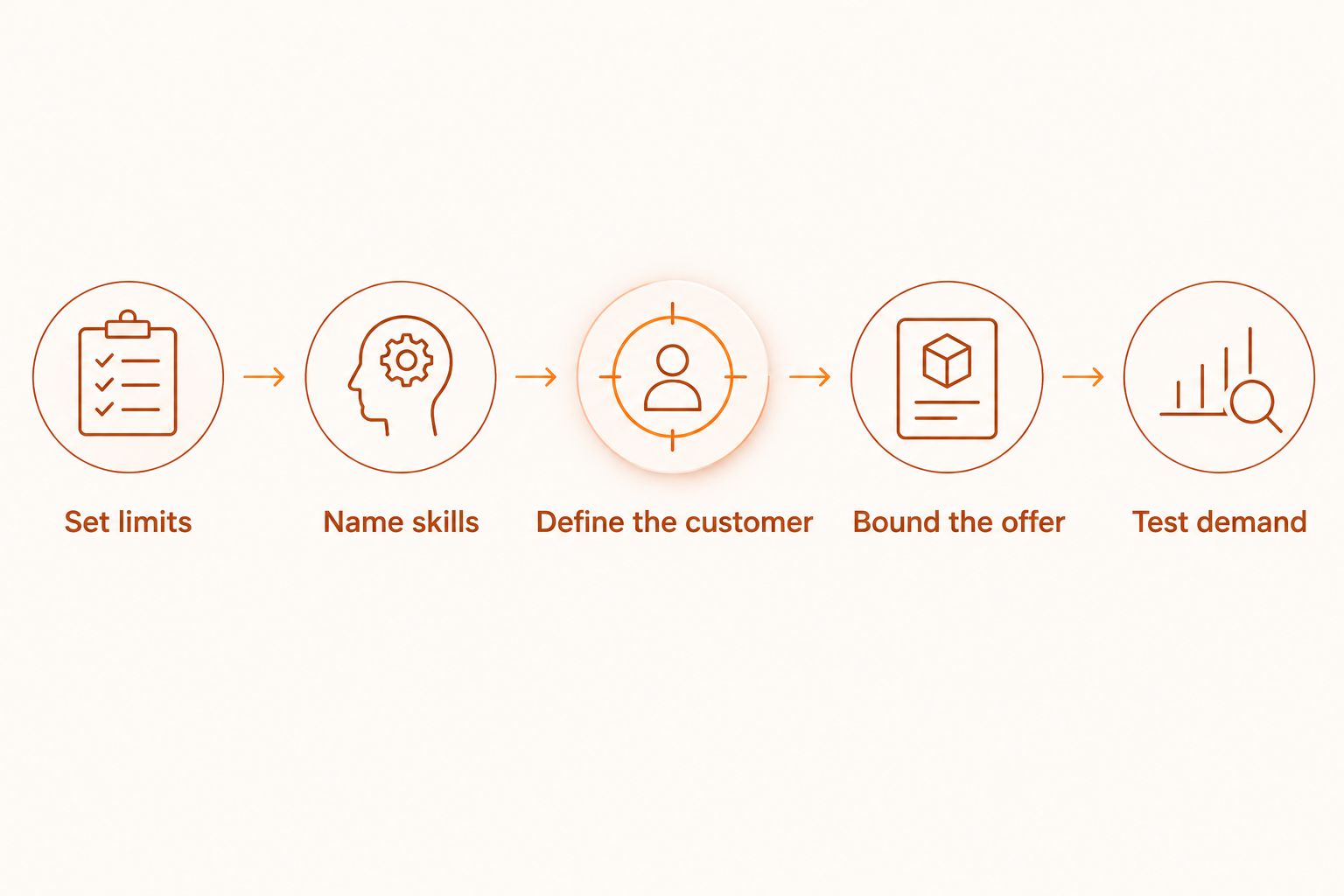
Follow this sequence:
- Set limits. State your spending ceiling, working hours, travel access, and existing equipment.
- Name skills. Describe tasks you can complete reliably, with examples of your work.
- Define the customer. Request a buyer with a specific problem and a realistic way to reach them.
- Bound the offer. Specify the deliverable, exclusions, completion conditions, and pricing logic.
- Test demand. Contact potential customers before buying equipment or building a large website.
Keep the same constraints when you compare results. Changing your available hours or spending ceiling between prompts makes it harder to tell whether a revised idea actually fits.
Why this matters
A business idea can sound reasonable while depending on something you do not have: weekday availability, reliable transportation, specialized equipment, or permission to perform the work. Those dependencies belong in the input, not in a surprise checklist after you commit.
For a first-time builder in 2026, the useful output is not a long list of possibilities. It is a small service you can explain, deliver, and put in front of a potential customer without breaking your limits.
A plan that fits your life is still only a plan. Customer conversations determine whether the problem matters enough for someone to consider your offer.
Set limits before asking for ideas
Write a constraint brief before opening a generator. Use plain language, and separate firm limits from preferences. Working only on weekends is a limit; preferring creative work is a preference.
Include these details:
- Money: What you can spend before receiving any customer payment, and what must remain untouched.
- Time: Your available work blocks, response windows, and delivery commitments.
- Skills: Tasks you can already perform, not subjects you merely enjoy.
- Equipment: Devices, software, tools, and workspace you already have permission to use.
- Location: Your service area, remote-work preference, and transportation access.
- Boundaries: Work you will not perform and credentials or permissions you do not hold.
Describe transportation directly. If you cannot travel to customer sites, say so. Naming your city alone does not communicate that restriction.
Also distinguish delivery time from total working time. Your schedule must cover customer messages, preparation, revisions, administration, and the actual service. An offer that fits only when those tasks disappear does not fit.
An illustrative constraint brief
The following is an example, not a recommended schedule or an earnings forecast:
I have 4 hours per week, split between two evening work blocks. I can format documents and organize spreadsheets. I have a laptop and internet access, but no car. I need remote work that does not require daytime calls. Suggest a service I can demonstrate in a 45-minute sample session using tools I already have. Keep any new spending within the limit I provide.
The numbers are planning inputs. They do not show how long every job will take or how quickly you will find a customer.
For your own 2026 brief, replace each example with your real situation. If your hours vary, explain which commitments you can reliably keep rather than presenting your best week as normal.
Name a skill you can demonstrate
Replace broad interests with observable tasks. Enjoying writing does not establish that you can deliver every writing service. Formatting a document into a consistent layout is a narrower task you can demonstrate.
Ask the generator to identify where your existing ability ends. If an idea requires expertise you do not have, reject it or narrow the scope before offering it to anyone.
A useful instruction is:
Suggest services based only on the tasks I list. For each service, identify the customer, the deliverable, the inputs I need from the customer, and any skill gap. Do not assume certifications, a portfolio, or experience I have not stated.
Pick work you can show, not work you can only describe. Build a sample with fictional information you create yourself. Do not use an employer's files or a customer's private information to demonstrate your ability.
A sample is evidence of what you can produce. It is not evidence that customers want it, and it should never be presented as paid client work when it is not.
Define the customer before polishing the offer
Ask who experiences the problem and who can authorize payment. Those are not always the same person. A vague audience such as “busy people” leaves you without a useful outreach message.
Request these details:
- The customer's role or situation.
- The task causing difficulty.
- The material they must supply.
- The finished result they would receive.
- A legitimate way to reach them.
For the document-formatting example, ask whether the customer already has finished text and needs presentation help. That distinguishes formatting from research, writing, editing, and subject-matter advice.
Do not accept invented customer names, testimonials, or demand statistics as validation. A generator can propose a customer hypothesis. You still need to speak with people who match it.
When reviewing a 2026 plan, mark each statement as either something you know, something you can verify, or something you need to ask a customer. Keep those categories separate.
Bound the offer before discussing price
Ask for an offer with a clear endpoint. “Help with admin” is open-ended; “format the customer-supplied document to an agreed layout” identifies a deliverable.
Request a scope that states:
- What you will deliver.
- What the customer must provide before work begins.
- Which tasks are excluded.
- How revisions will be handled.
- What counts as completion.
- How payment and cancellation terms will be agreed.
Ask the generator to explain its pricing assumptions without treating its suggestion as a market fact. Your decision needs to account for delivery effort, administration, direct expenses, revision exposure, and the scope the customer accepts.
Do not quote a job whose boundaries you cannot explain. Unclear inputs and unlimited revisions make it difficult to judge whether the work fits your available time.
Check startup costs separately from the customer quote. List required tools, consumables, travel, business administration, and any relevant insurance or permission requirements. Verify applicable requirements with official sources before accepting work; a generated checklist is not legal advice.
Which starting point fits your situation?
ChatGPT, free business-idea lists, and a dedicated generator are different starting points. Choose based on the task you need help completing, not a claim that any option guarantees better business results.
| Starting point | Best for | Useful role | Limitation |
|---|---|---|---|
| HustleForge | First-time builders seeking a personalized side-hustle plan | Generates plans covering offer, pricing, and launch steps around stated constraints | A generated plan does not establish customer demand or verify local requirements |
| ChatGPT | Builders who want to write and revise their own constraint brief | Can respond to prompts and help revise a proposed offer | You must state the limits and check the resulting assumptions |
| Free business-idea lists | Builders looking for starting categories | Provide ideas to inspect and reject | A generic list does not establish that an idea fits your schedule, skills, or location |
For a 2026 comparison, give each approach the same brief. Judge whether the result identifies a customer, respects your limits, and provides an action you can take—not whether it produces the longest answer.
The optional Launch Blueprint is another planning step, not a substitute for customer contact. Use planning help when you need a clearer offer or launch sequence. Do not keep generating documents to avoid testing the idea.
Why generated business ideas vary
Generated plans vary because the brief changes what is feasible. Review these drivers before deciding that a different idea is automatically better:
- Skill detail: Specific tasks support narrower offers than broad interests.
- Budget: Required purchases can make an otherwise suitable idea fail your spending limit.
- Available time: Customer communication and revisions must fit alongside delivery.
- Transportation: An on-site service needs travel access that remote work does not.
- Location: Service area and applicable requirements affect what you can offer.
- Customer inputs: Missing files, instructions, or access can change the work involved.
When an output ignores a limit, request a correction using that exact limit. Do not quietly expand your schedule or spending to make the suggestion work.
If every proposed offer requires a missing capability, return to your skill list. Narrow the task or choose something you can already demonstrate instead of accepting a larger commitment.
How do you test the idea without building a whole business first?
Start with a sample, an offer statement, and a customer conversation. You do not need to turn every suggestion into a logo, a website, or a collection of subscriptions before asking whether the problem is real.
Use this illustrative test sequence:
- Create a sample with fictional data.
- Write a short description of the customer, deliverable, and exclusions.
- Ask a potential customer how they handle the task now.
- Show the sample and ask what would make it useful.
- Revise the offer based on the response.
For an illustrative 1-week test window, your goal is to gather specific feedback, not to promise yourself a sale. Record objections about the result, timing, trust, scope, and purchasing process.
Avoid leading questions such as whether someone likes your idea. Ask about their current task and whether your proposed deliverable solves a problem they actually have.
What should you ask the generator after the first answer?
Ask the generator to check its plan against your original constraints. Tell it to identify dependencies rather than fill gaps with assumptions.
Use this follow-up:
Review this offer against my available hours, spending limit, skills, equipment, location, and transportation. Identify any conflict. Separate customer evidence from assumptions. Give me the next action that checks the most important assumption without exceeding my limits.
Then request a stop condition. If the work needs unavailable credentials, travel, or hours, the plan should be revised before you accept a customer commitment.
FAQ
What's the best way to use an AI business idea generator?
Give an AI business idea generator your actual skills, spending limit, available hours, location, and transportation restrictions. Ask for a specific customer, bounded offer, and launch action, then check demand with potential customers.
Is HustleForge better than ChatGPT for a first business plan?
HustleForge suits builders seeking a personalized side-hustle plan, while ChatGPT suits builders who want to write and revise their own prompts. Neither a generated plan nor a conversational answer proves customer demand.
Can I use a business idea generator if I only have 4 hours per week?
An illustrative 4 hours per week can be entered as a firm planning constraint, not a promise that a business will fit. Require the plan to include customer communication, preparation, delivery, and revisions within your actual schedule.
Can I start with a free business-idea list instead?
A free business-idea list can help you identify categories to examine. Check each idea against your skills, spending limit, available hours, and transportation before choosing an offer.
Should I buy equipment before contacting customers?
Check the customer problem and offer before making purchases for an untested idea. If equipment is essential even for a sample, include that expense in your feasibility check rather than assuming demand will cover it.
Can a generated business plan guarantee income?
A generated business plan cannot guarantee income. Treat its customer, offer, and launch suggestions as assumptions to check, not as earnings evidence or verified success stories.
What should I include in a business idea prompt in 2026?
A 2026 business idea prompt should include your current skills, spending limit, available work blocks, equipment, location, and transportation access. State exclusions and request a customer, deliverable, scope, and concrete next action.
One last thing
Ask what would make the idea a bad fit for you. A useful plan should survive that question without changing your limits.
If the answer requires daytime availability you do not have, travel you cannot manage, or skills you cannot demonstrate, reject the offer as written. Narrowing the job is progress. Ignoring the constraint is not.