Beginners’ service businesses are small, skill-based offers built to solve a customer’s specific problem and establish a manageable first sale. The right business ideas for beginners fit your current skills, available time, startup budget, and transportation—not an imagined version of your life.
- Business ideas for beginners work best as narrow services with a clear customer, deliverable, and stopping point.
- HustleForge business planning suits first-time builders who need an offer shaped around their skills, budget, time, and location.
- Start with existing equipment and a sample before spending on branding or subscriptions.
- ChatGPT and free business-idea lists support exploration; neither replaces customer conversations or checking local requirements.
Why service-business planning matters for beginners
If you have never sold a service, you need more than a list of ideas. You need to explain what you do, decide what the customer receives, and recognize work you should decline. A narrow offer makes those decisions easier.
The guide to starting a side hustle from your skills covers the move from an ability to a first offer. This guide focuses on beginners making that move in 2026: choosing manageable work, showing proof, and asking for a sale without pretending to be an expert.
Your first business should be small enough to test without buying a new identity. A website, logo, or subscription does not establish that someone wants your service.
Build your first service offer
Match your constraints
Start with a free inventory on paper or in a spreadsheet. Write down what you can already do, what equipment you own, when you can work, and where you can realistically travel. Treat each answer as a boundary, not a problem to hide.
For an illustrative planning exercise, reserve 30 minutes to complete this inventory. That is a suggested work session, not a claim about how long starting a business takes. A weekday-evening schedule points toward different work than an open Saturday does.
Separate service delivery from everything around it. Messages, travel, revisions, preparation, and payment administration all occupy time. If your schedule only fits the task itself, the offer does not fit yet.
- List skills you can demonstrate without another course.
- Mark recurring work windows you can actually protect.
- Record equipment, transportation, and spending limits.
- Remove ideas that depend on resources you do not have.
Choose a narrow service
Choose work with a visible finish line. A customer should understand the result without needing a lesson in your business model. Narrowing the deliverable also helps you recognize requests that belong outside the agreement.
The following are starting points, not promises of demand. Each option requires the stated ability. Choose the one you can perform reliably, then check whether a reachable customer needs it.
| Service option | Best for | Practical advantage | Key limitation |
|---|---|---|---|
| Document formatting | Beginners comfortable with word processors | Produces a visible before-and-after sample | Confidential files require careful handling; complex layouts need stronger skills |
| Spreadsheet cleanup | Beginners who already understand spreadsheet basics | Can focus on a defined file and agreed changes | Incorrect edits can damage data; unfamiliar formulas are outside a beginner offer |
| Basic yard tidying | Beginners with suitable tools and local transportation | Lets you define a physical area and specific tasks | Weather, disposal, safety, and travel affect the work |
| Nontechnical tutoring | Beginners who can clearly explain a subject they know | Can use a focused lesson and existing learning materials | Teaching skill matters; work with minors requires appropriate safeguards |
Do not choose tutoring because you once passed a class, or spreadsheet work because you own a laptop. Skill must support the offer. If you cannot demonstrate the task, practice before selling it.
- Pick 1 service offer for the initial test.
- Name the customer who needs that specific task.
- Describe the deliverable in ordinary language.
- Write down the tasks you will not accept.
Turn your idea into a plan
Write a manual plan before you open another tool. Use these headings: customer, offer, setup cost, time required, price, and next action. Under each heading, record a decision or an unanswered question—not a motivational statement.
For example, an illustrative document-formatting offer could cover headings, spacing, and page numbering in a customer-provided file. It would exclude writing new content, fact-checking, and specialist design. That boundary gives you something concrete to discuss.
HustleForge is the faster drafting path: its free business generator produces personalized side-hustle plans covering the offer, pricing, and launch steps. The plan is shaped by your skills, budget, time, location, and transportation constraints. An optional Launch Blueprint is another planning option, not a prerequisite for speaking to customers.
HustleForge business planning is best for first-time builders who need a plan shaped around their actual constraints. Its limitation is straightforward: a generated plan is not customer demand, verified local compliance, or proof that you can deliver the work.
- Write the manual version before comparing suggestions.
- Enter your actual constraints, including transportation limits.
- Check pricing suggestions against your costs and scope.
- Replace broad launch tasks with a specific next action.
Make a sample before buying tools
Build proof using material you own or have permission to use. A document-formatting sample can show an original and revised layout. A spreadsheet-cleanup sample can use fictional records clearly marked as sample data.
The sample must match the service you intend to sell. A polished presentation does not prove that you can clean a spreadsheet. A yard photo does not establish that you can safely handle unfamiliar equipment.
Set aside 60 minutes for an illustrative sample-making session in your 2026 launch plan. This is a suggested time box, not a delivery estimate. If the sample takes longer, record why; the difficulty tells you what to practice or remove from the offer.
Avoid buying software just to make the service look professional. First identify the exact task your current equipment cannot perform. Then decide whether that gap justifies spending or whether a simpler offer solves it.
- Use fictional, personal, or permission-cleared material.
- Show the actual deliverable, not a claimed outcome.
- Record preparation and completion time separately.
- Label samples honestly; never imply they are client work.
Ask a reachable customer
Find a person whose situation matches the offer. Start with existing contacts, community introductions, or an appropriate group that permits service posts. Follow the group’s rules and avoid copying the same pitch into unrelated spaces.
Ask about the task before presenting the solution. For document formatting, ask how the person currently prepares files and what causes rework. A real problem is more useful than a polite compliment about your idea.
An illustrative outreach goal is 3 customer conversations before you change the offer. This is a practice target, not an expected conversion rate. Record what people say, including reasons they do not need the service.
Keep the request small and specific. Ask whether the person wants to see a sample or discuss a defined task. Do not send confidential files to a planning tool without permission, and do not treat interest as an agreement to pay.
- Identify people who match the customer description.
- Ask about the task and their current workaround.
- Offer a relevant sample with permission.
- Record objections without arguing against them.
Agree on scope and review the result
Before accepting work, write down the deliverable, exclusions, deadline, customer responsibilities, payment terms, and revision boundaries. A plain-language written agreement is a practical starting point; legal requirements depend on the work and location.
Set the proposed price after accounting for preparation, delivery, travel, supplies, and administration. Do not copy a number from a generic idea list and assume it covers your situation. The customer needs to understand what the amount buys.
In your 2026 work log, compare what you expected with what happened. Track actual time, direct expenses, questions, and changes. That record supports a decision to repeat, narrow, or stop the service; it does not guarantee a profitable business.
Check applicable local licensing, tax, insurance, and property-access requirements before taking work. For tutoring involving children, establish appropriate parent or guardian arrangements and safeguarding procedures. Decline work that exceeds your competence.
- Confirm scope and payment terms before starting.
- Check requirements for the service and location.
- Protect customer files, property, and personal information.
- Review actual effort before accepting similar work again.
Compare planning options before adding complexity
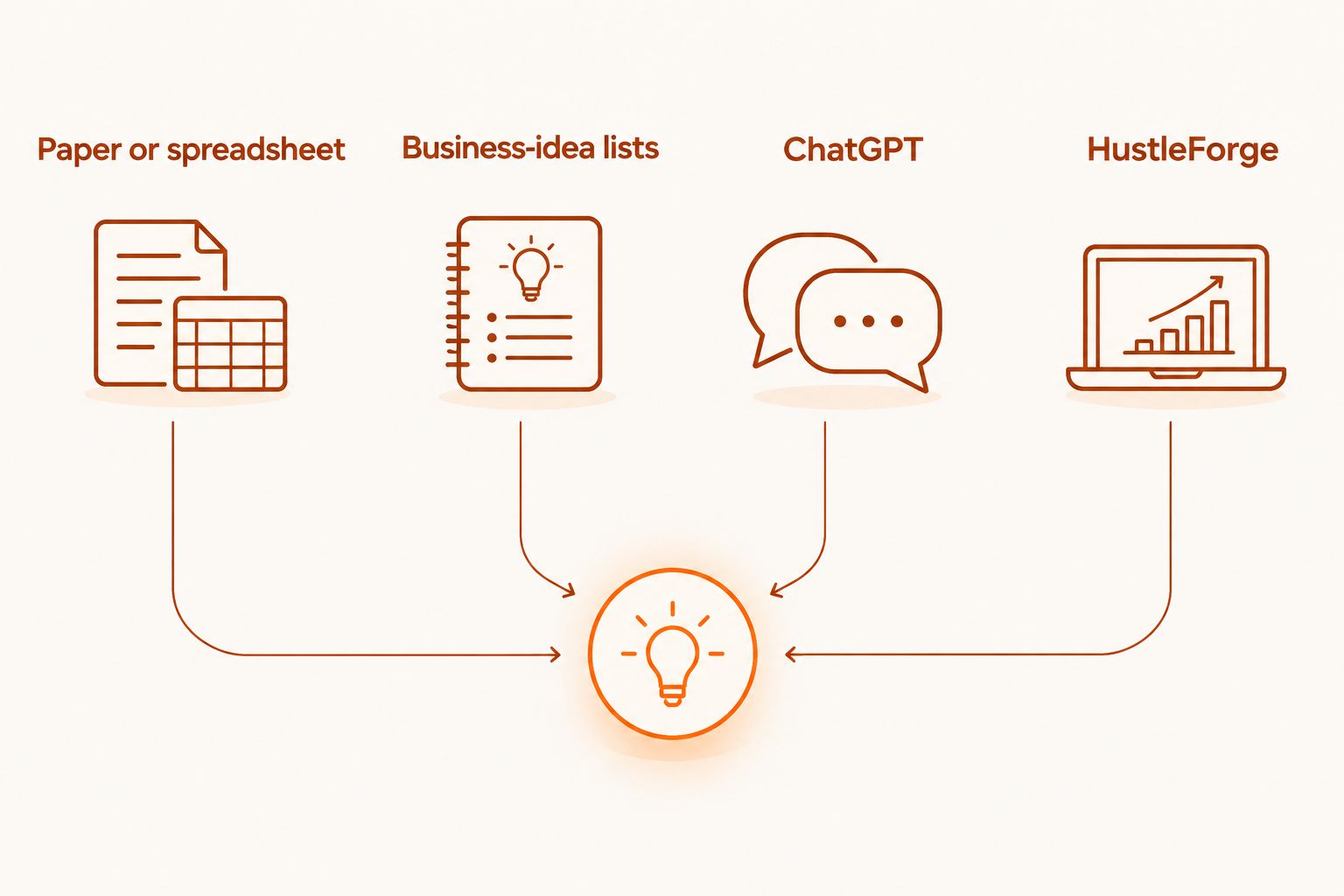
Use the tool that addresses your current obstacle. If you cannot name a customer, more launch instructions will not solve that problem. If you already have a customer and a task, another idea list can become a distraction.
| Planning option | Best for | Useful capability | Key limitation |
|---|---|---|---|
| Paper or spreadsheet | Beginners who want direct control | Keeps assumptions, costs, and decisions visible | You must create the structure and identify missing steps |
| Free business-idea lists | Beginners exploring possible services | Introduces options you can screen against existing skills | A general list does not account for your personal constraints |
| ChatGPT | Beginners comfortable writing and checking prompts | Can draft offers, questions, and planning outlines from your instructions | Output needs checking; include constraints and verify factual claims |
| HustleForge | First-time builders seeking personalized business planning | Generates offer, pricing, and launch steps from personal inputs | Suggestions still require a skills check, cost check, and customer test |
For 2026, keep the selection rule simple: choose the planning method that helps you make the next decision, not the longest document. Recheck assumptions when your schedule, transportation, or available equipment changes.
A plan only becomes useful when it changes an action. Finish with a named customer type, a defined task, and a next step you can complete within your available work window.
Build a plan around your constraints
Turn your skills, budget, time, and location into an offer and concrete launch steps.
Common mistakes beginners make
Offering everything you know
A broad menu makes it harder to explain what a customer receives. Start with the task you can demonstrate and finish reliably. Add work only after you understand the effort and risks involved.
Spending before testing the offer
Subscriptions, branding, and new equipment create expenses before they establish demand. List required purchases separately from optional improvements. Ask whether a smaller service would let you start with what you own.
Treating a generated price as a decision
A suggested price is not evidence that your costs are covered or that a customer will accept it. Check the scope, time, expenses, and payment arrangements yourself. Discuss the deliverable and proposed price before work begins.
Promising results outside your control
Formatting a document is a deliverable. Getting someone hired is not a result a beginner formatter can promise. Sell the work you can complete, not the life outcome the customer hopes follows.
Ignoring travel and customer communication
An appointment is not just the time spent doing the task. Account for travel, preparation, messages, and follow-up. If these do not fit your schedule, reduce the service area or choose work you can deliver remotely.
FAQ
What are the best business ideas for beginners who have never sold anything?
The best starting options are narrow services you can already demonstrate, such as document formatting, basic spreadsheet cleanup, or suitable local yard tasks. Choose by skill, reachable customers, equipment, and available time—not by an earnings claim.
Can I start a service business without spending money on software?
You can start planning, making samples, and talking to customers with tools you already own. Delivery requirements vary, so check necessary equipment, permissions, and local obligations before accepting work.
How do I find my first customer without an audience?
Start with reachable people who match your customer description and ask about the specific task you offer. Use relevant introductions or permitted community posts, then show a sample with permission.
Is ChatGPT better than a business-plan generator for beginners?
ChatGPT fits beginners who want to direct and revise their own prompts; a personalized generator fits beginners who want a structured starting plan. Neither replaces checking skills, costs, local requirements, or customer interest.
What does HustleForge help a beginner plan?
HustleForge generates personalized side-hustle plans covering the offer, pricing, and launch steps. Its inputs account for skills, budget, time, and location; you still need to check the plan against real work and customer feedback.
How should I price my first service?
Price the defined scope after accounting for preparation, delivery time, direct expenses, travel, and administration. Agree on what is included and how additional requests will be handled before starting.
What should I focus on first when starting in 2026?
Focus first on a demonstrable skill, a reachable customer, and a bounded offer. Make a sample and discuss the task before spending on branding or optional tools.
One last thing
Your strongest first-offer sentence includes a boundary: what you do and what you do not do. Write it before outreach. If you cannot name the stopping point, you are not ready to promise a delivery date.