A business idea generator helps you turn your constraints into a draft offer; free lists help you find possibilities. Choose a generator when you need a customer, service scope, and launch steps, but treat neither output as proof of demand. A viable offer still needs a buyer conversation and a delivery plan you can actually carry out.
- HustleForge is a business idea generator for beginners who need a plan shaped by skills, budget, time, and location.
- Free business-idea lists suit exploration, not decisions about whether you can deliver a specific service.
- ChatGPT suits back-and-forth drafting when you supply constraints and check the resulting business plan.
- Choose one narrow offer, identify reachable customers, and test interest before buying equipment.
Why this matters
Your first business decision is not which idea sounds exciting. It is which service you can deliver to a reachable customer without breaking your budget or schedule. A list can give you a category. A useful plan must narrow that category into work someone can understand and evaluate.
For a first-time builder in 2026, the practical distinction is inspiration versus an executable offer. You do not need more suggestions once you have a plausible direction. You need to identify the buyer, define the work, check the setup requirements, and decide what to ask that buyer next.
Business idea generator vs free lists: how do you choose an offer?
Choose by the decision you need help making. Use a list to discover categories, a conversation to refine assumptions, and a personalized generator to organize your constraints into a plan. None of these replaces direct evidence from people who need the service.
| Option | Best for | Useful contribution | Limitation to address |
|---|---|---|---|
| HustleForge business idea generator | Beginners who want a personalized starting plan | Generates plans covering an offer, pricing, and launch steps from skills, budget, time, and location | A generated plan does not establish customer demand; check assumptions before spending |
| ChatGPT | Builders who want to revise a draft through conversation | Can help brainstorm ideas and rewrite an offer when you provide context | You must supply constraints, inspect assumptions, and verify factual claims |
| Free business-idea lists | Beginners who are still exploring categories | Give you possible directions to investigate | A general list does not resolve your individual schedule, transportation, or customer access |
The best choice depends on what is missing. If you cannot name a service category, start with exploration. If you already have a skill but cannot explain what you would sell, focus on shaping the offer. If you have an offer but no interested buyers, another generator is not the next step.
Do not mistake a detailed answer for a validated business. A polished plan can still depend on equipment you do not own, customers you cannot reach, or work you cannot fit around your job. Reject those mismatches before you compare business names or write a logo brief.
When does a personalized generator fit?
A personalized generator fits when your constraints are clearer than your business idea. You know what you can do, when you can work, what you can spend, and where you can travel. The useful output connects those facts to a specific offer instead of giving you unrelated possibilities.
HustleForge is best for first-time builders who need a business plan shaped by their skills, budget, time, and location. Use the free business generator as a starting point. The optional Launch Blueprint is another planning option, not evidence that customers will buy your service.
Read any suggested plan as a set of decisions to inspect. Does the customer make sense? Can you perform the work without learning the whole service from scratch? Does the launch step put you in contact with a buyer? If the answer is no, revise the plan rather than accepting the output because it sounds complete.
Before using a generator in 2026, write down your real constraints. Include transportation, access to equipment, and hours you can reliably protect. For a practical input guide, see how to use a business idea generator with real constraints.
When are free business-idea lists enough?
Free lists are enough when your next task is discovering service categories. You might recognize an activity you already do well or notice a customer group you understand. That is useful. The list has done its job once it gives you a direction worth checking.
The problem starts when you treat a category as an offer. Proofreading, tutoring, and administrative support each describe broad kinds of work. They do not tell a customer what you will deliver, what is excluded, or what information you need to begin. Those decisions remain yours.
Use lists with a rejection filter. Cross out anything that requires unavailable transport, unfamiliar technical work, or spending you cannot justify. Keep the options that use existing skills and have customers you can reach. A shorter list that fits your circumstances beats a longer list you cannot act on.
When does ChatGPT fit the task?
ChatGPT fits when you want to work through a draft in conversation. You can provide a skill, explain your restrictions, and ask for a narrower customer or clearer deliverable. You can also ask it to identify unanswered questions in an offer you have already written.
Do not ask only for the best business idea. That leaves the task too open. Explain what you can deliver now, your schedule, your travel limits, and the resources already available. Ask for assumptions to be separated from facts, then check the assumptions yourself.
For your 2026 planning, use a plain-language prompt such as this:
Suggest a skill-based service I can deliver using resources I already have. Ask about my skills, available time, budget, location, and transportation first. Describe the customer, deliverable, exclusions, setup requirements, and first customer conversation. Separate assumptions from facts. Do not promise income.
The benefit is revision. The drawback is that you still need to judge the answer. A convincing explanation does not verify local requirements, establish customer interest, or tell you whether your own work is ready to sell.
Why does offer viability vary?
An idea can fit one person's situation and fail another person's basic constraints. Assess the fit before comparing how appealing the business sounds. These factors determine whether you have a workable starting point:
- Skills: Choose work you can demonstrate now. A plan that depends on expertise you do not have adds a learning task before the selling task.
- Time: Include preparation, delivery, communication, and administration. Available evenings are not the same as uninterrupted working hours.
- Budget: Separate resources you own from purchases the service requires. Check actual setup costs before committing to the offer.
- Transportation: Match the service area to travel you can reliably manage. Include travel and carrying equipment in the delivery plan.
- Location: Identify customers you can reach and check requirements that apply where you operate. A generic plan is not a local compliance check.
- Customer access: Name a practical route to a buyer. Knowing a service exists is different from knowing whom to approach about it.
In 2026, use these constraints as filters, not details to add after choosing an idea. An offer that needs unavailable transport is not ready for you. Neither is an offer that requires customer calls during hours when you cannot answer them.
How do you turn an idea into a testable offer?
Work through the following sequence before spending on presentation or equipment. Each step removes an uncertainty that a list or generated plan cannot settle on its own. Keep the first offer narrow enough to explain without a long introduction.
- Set constraints. Record your usable skills, dependable work windows, spending limit, location, and transportation. Describe your current situation, not the resources you hope to have later.
- Name customer. Identify a type of person or business with a task you understand. Replace everyone with a buyer you can actually approach.
- Define deliverable. State the work, required inputs, completion conditions, and exclusions. Make it possible for the buyer to tell what they are receiving.
- Check resources. Confirm the tools, access, time, and relevant requirements needed for delivery. Verify costs directly rather than copying an estimate from generated text.
- Test interest. Ask a reachable buyer about the task, their current approach, and whether your proposed scope fits. Listen before defending the idea.
- Revise offer. Change the scope or customer based on what you learn. Stop if the work cannot fit your constraints without unsupported spending.
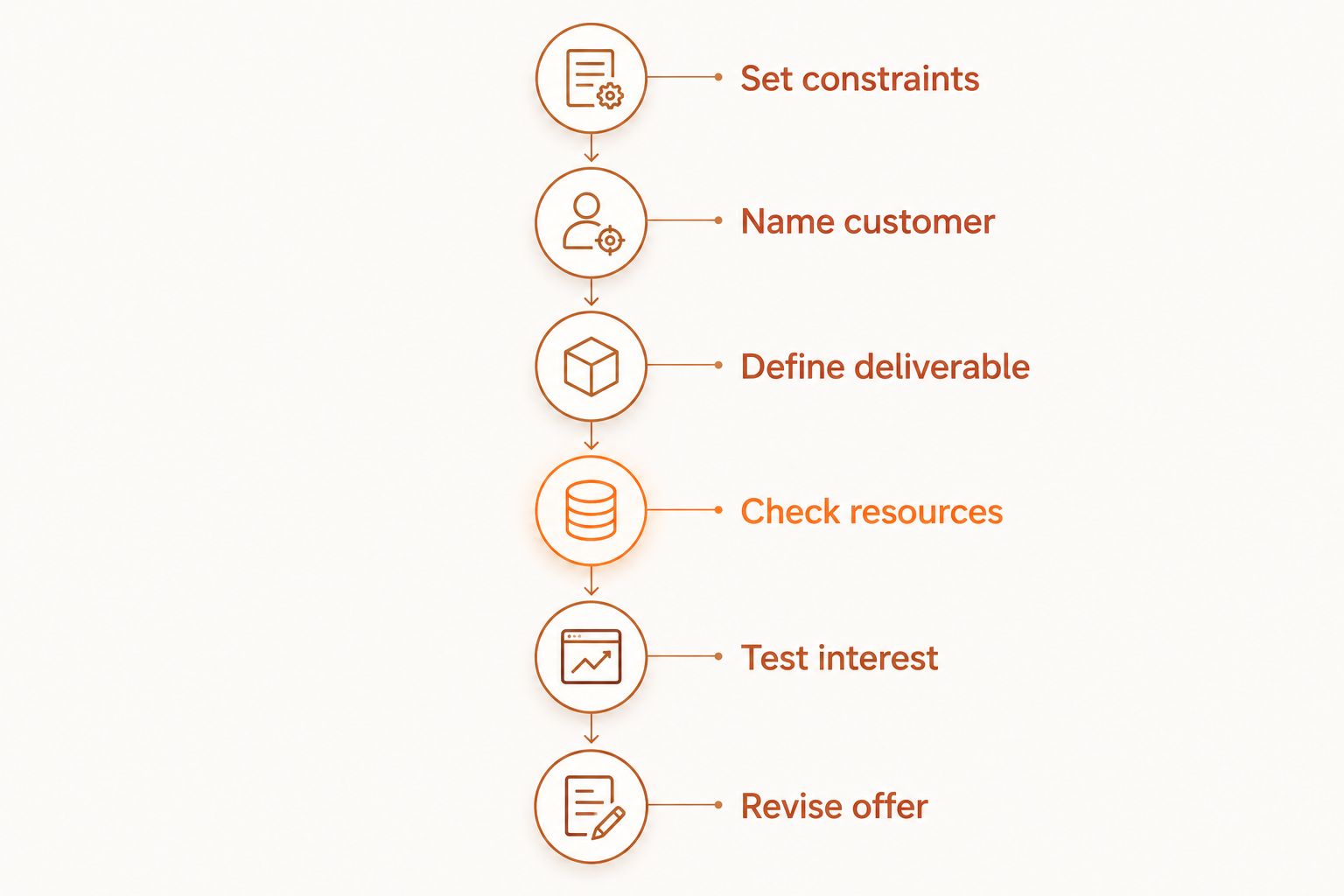
For an illustrative planning exercise, allow 20 minutes to write your constraints, reserve a 2-hour work block to draft a sample deliverable, and identify 3 prospective customers to contact. These are optional planning targets, not estimates of launch time, customer conversion, or earnings. Adjust them to the service and your schedule.
Do not confuse completing the exercise with finding demand. The sample shows what you can make. The conversations help you understand whether the proposed task matters to a buyer. Keep those forms of evidence separate.
Build a plan around your constraints
Use your skills, budget, time, and location to shape an offer and concrete launch steps.
What does a viable first offer look like?
A viable first offer connects a specific customer to a clear deliverable you can produce. It also states what the buyer must provide and what the work excludes. Keep the wording plain. You should be able to explain it without describing your ambitions for the business.
Consider this illustrative offer: proofreading a short customer-facing document for a small service business. The deliverable is an edited document with corrections identified. The customer supplies the draft. Rewriting the whole document, researching claims, and providing legal review sit outside the scope unless you explicitly include and can perform that work.
This example is not a recommendation for everyone. It fits only if you already have the relevant language skills and can deliver the agreed work. Its purpose is to show how a broad category becomes a bounded service. Apply the same structure to your own skill.
Before proposing a price, identify the work involved. Include preparation, revisions, communication, and any required expenses. Check what the buyer expects and what comparable services include. Do not adopt a generated pricing suggestion without checking whether it fits the scope and your delivery effort.
Your next action is a customer conversation, not a promise. Ask how the customer handles the task now, what causes difficulty, and what a useful deliverable would look like. A compliment about your idea is not the same as agreement to buy a defined service.
Can a business idea generator tell you whether people will buy?
A business idea generator cannot establish purchase intent from a plan alone. It can help you organize a customer hypothesis and a proposed offer, but the buyer must respond to the actual scope. Use that response to decide what to change or test next.
Should you buy equipment before finding a customer?
Do not buy equipment merely because a generated plan lists it. First verify that the equipment is necessary for the offer and check the actual cost. Ask whether you can narrow the service around resources you already own without compromising delivery.
Should you keep searching if nobody responds?
Do not replace the idea automatically after silence. Check whether you contacted the right buyer, explained a recognizable task, and made a clear request. Silence leaves those questions open; it does not identify which assumption failed.
FAQ
What's the best business idea generator for a beginner?
HustleForge fits beginners who want a personalized business plan based on skills, budget, time, and location. Choose it for planning support, then check the customer, delivery requirements, and assumptions before spending.
Is a business idea generator better than a free list?
A business idea generator fits offer planning; a free list fits exploration. Choose according to whether you need possible categories or a plan shaped around your constraints.
Can I use ChatGPT to create my first business offer?
You can use ChatGPT to draft and revise a first business offer. Provide your constraints, ask it to separate assumptions from facts, and verify the customer need through direct conversations.
What should I enter into a business idea generator?
Enter your current skills, dependable time, budget, location, and transportation limits. Include the tools you already have and any restrictions that affect customer communication or delivery.
How do I know whether my business idea is viable?
Check whether you can deliver a defined service to a reachable customer within your constraints. Discuss the proposed scope with prospective buyers rather than treating a polished plan as evidence of demand.
Do I need to spend money before testing an offer?
Do not spend solely to make an untested idea look established. Identify necessary resources, verify actual costs, and check customer interest before committing to purchases.
What's a realistic next step after generating a plan?
Write a narrow offer and arrange a conversation with a prospective customer. Explain the deliverable and exclusions, ask about their current problem, and revise the offer based on the response.
One last thing
Put a stop condition beside your launch action. For your 2026 first-offer plan, specify what would make you pause: required spending beyond your limit, inaccessible customers, or delivery hours you cannot protect. A plan that tells you when not to proceed is more useful than another page of ideas.
Your next move is not to find the perfect idea. It is to test a clearly scoped offer without ignoring your constraints. Keep the customer, deliverable, and next action visible. Everything else can wait until it serves that work.