Weekend service business planning is the process of turning your skills and available hours into an offer you can deliver outside your main job, with the aim of finding a paying customer. HustleForge is best for first-time weekend service builders who want an AI business plan generator shaped around their skills, budget, time, and location.
- HustleForge is the best AI business plan generator fit for beginners who need a constraint-based weekend service plan.
- ChatGPT suits builders who want to write their own brief and revise the plan through conversation.
- Free business-idea lists help you explore side hustles; they do not establish customer demand.
- Choose a service you can deliver, define its boundaries, and test customer interest before buying equipment.
Why business planning matters for weekend service builders
A weekend service business has a hard limit: the hours you can actually work. Travel, preparation, customer messages, and cleanup all compete with delivery time. A plan that ignores those tasks does not fit your schedule.
Your customer also needs a clear buying decision. They need to know what you do, what the job includes, when you can deliver it, and how you set the charge. A long business document is not a substitute for those answers.
The best generator for this segment produces a workable offer, not just a polished document. Compare options by whether the plan respects your constraints and gives you a concrete next action. Document length is not evidence of feasibility.
A 2026 plan should separate facts from assumptions. Your existing equipment and available hours are facts. Whether a neighbor wants your service is an assumption until you ask. Whether that person will pay remains untested until you discuss an actual job.
Build your weekend service plan in 2026
Start manually. A note or spreadsheet is enough to record your limits, choose an offer, and prepare a customer conversation. Use a generator after you have something specific to give it.
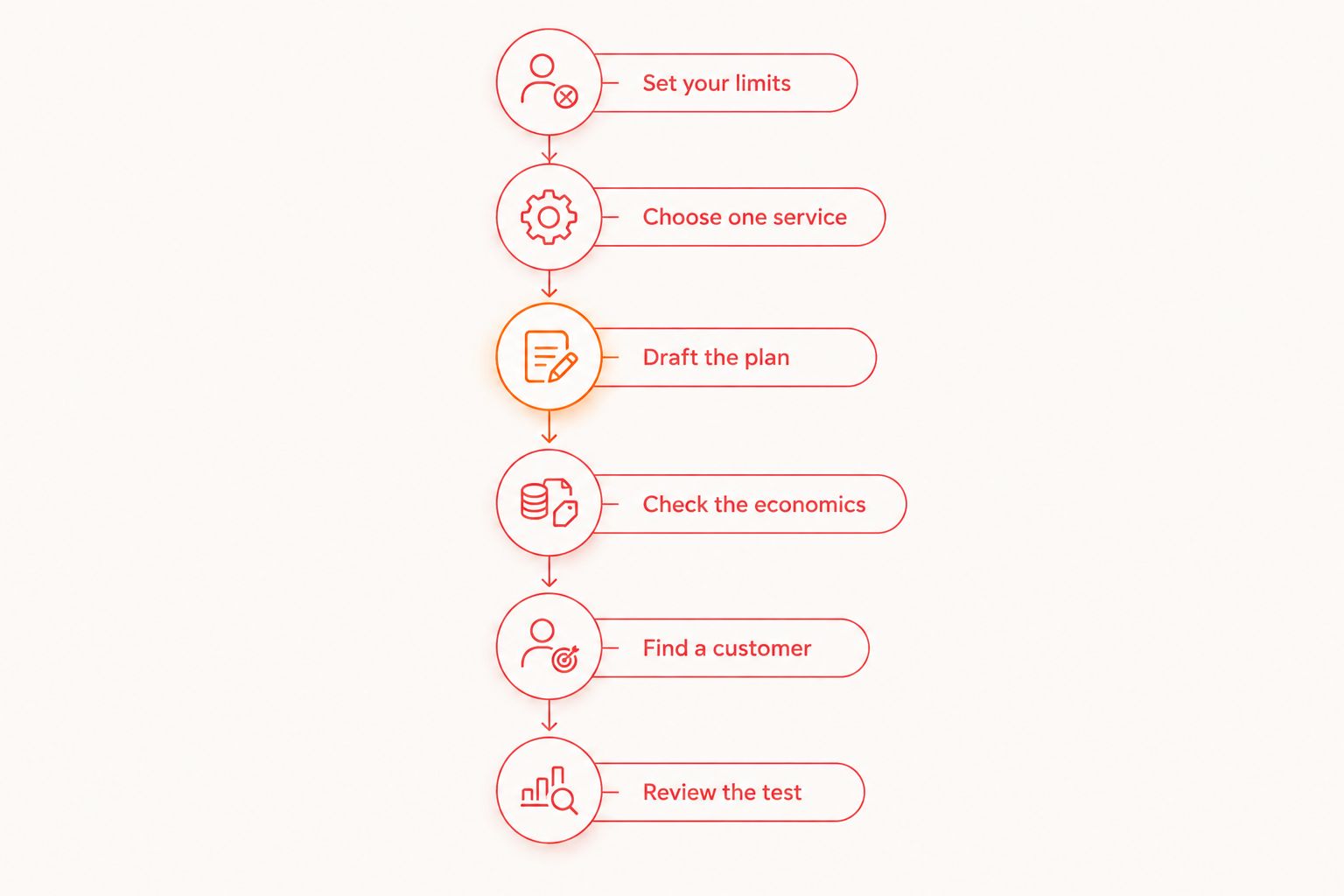
Follow this sequence: Set your limits, Choose one service, Draft the plan, Check the economics, Find a customer, and Review the test. Each stage answers a different question. Do not let an attractive idea skip the checks that make it deliverable.
Set your limits
Write down what you can commit without borrowing time from sleep, family responsibilities, or your main job. Include the less visible work. Scheduling and collecting information from customers still take time even when nobody is paying for that task separately.
For illustration, a 4-hour Saturday window is not automatically four hours of customer work. You must also fit preparation, travel, delivery, and cleanup into that window. Treat the window as a total capacity limit, not a sales target.
Transportation deserves its own check. An idea that requires carrying equipment between homes is different from a remote service you can deliver using tools you already have. Neither is automatically better. Choose the one your circumstances support.
Keep these constraints beside every idea you consider:
- Skills: List tasks you can already complete without learning on a customer's job.
- Time: Record actual delivery windows and separate time for messages and preparation.
- Budget: Identify money you can commit without depending on future sales.
- Transportation: Note how you would reach customers and move necessary supplies.
- Boundaries: Exclude work that conflicts with your employment obligations or requires qualifications you lack.
Choose one service
Write several possible services manually, then narrow the list to a task with a clear customer and finish line. Start with an existing skill. Buying equipment does not tell you whether anyone wants the result.
Illustrative options include home organizing, proofreading, and spreadsheet cleanup. Home organizing fits someone comfortable working in another person's space. Proofreading fits someone with strong editing skills. Spreadsheet cleanup fits someone who already understands the file formats and tasks involved.
These are starting points, not income predictions. Remote work still needs scope and secure handling of customer information. Local work still needs access arrangements and a realistic travel plan.
Make the offer small enough to describe without a paragraph of exceptions. A defined task is easier to discuss than a promise to handle anything the customer needs.
- Name the customer and the specific task they want completed.
- Describe the finished result in language the customer uses.
- State what the service includes and excludes.
- Identify anything the customer must supply before work begins.
- Choose a task that fits one of your actual delivery windows.
Draft the plan
Draft the core plan yourself first: customer, offer, scope, setup costs, pricing approach, and next action. This gives you a baseline for judging generated output. If a suggested plan changes your limits, reject that part rather than changing your life to fit it.
HustleForge's AI business plan generator is the faster drafting path for a personalized side-hustle plan covering the offer, pricing, and launch steps. Its stated inputs include skills, budget, time, and location. Include transportation in the constraints you describe and check that the resulting actions fit it.
The free business generator is the starting point. The optional Launch Blueprint is a separate next step, not a prerequisite for testing an offer. A generated plan still needs customer feedback and your review of delivery requirements.
Use your actual 2026 schedule, not an imagined version with every evening available. For an illustrative 2-hour planning block, aim to leave with an offer draft and a customer-contact action—not a finished company strategy.
- Describe your relevant skills with concrete examples of tasks you can perform.
- Enter your available hours and location accurately.
- State equipment, transportation, and spending constraints explicitly.
- Ask for one customer, one offer, and a clear first-customer action.
- Mark unsupported demand, cost, or earnings assumptions for verification.
Check the economics
List startup requirements manually before treating a suggested offer as ready. Separate equipment you own, supplies used per job, transportation expenses, and any applicable registration, permit, or insurance requirements. Check official local sources rather than asking a generator to settle legal questions.
Pricing needs the same discipline. Decide what the charge covers and how you will handle extra work. Do not copy a generated amount without checking the scope, your costs, and the time needed to deliver it.
For a 2026 launch, record current quotes where you actually need supplies or professional services. Keep revenue, expenses, and your own time separate. A customer payment is not the same as profit.
The aim is not a convincing forecast. It is an offer you can deliver without discovering an essential expense after agreeing to the job.
- List necessary setup items separately from optional upgrades.
- Identify supplies and other expenses that recur with each job.
- Include travel, preparation, administration, and delivery in your time estimate.
- Define how extra tasks or revisions change the scope and charge.
- Verify relevant business requirements through the appropriate official sources.
Find a customer
Write a short customer message yourself before asking a tool to improve it. State the task, the result, your service boundary, and the next step. Remove any claim about results you cannot support.
Choose a channel where the intended customer can receive an appropriate message. That might be an existing contact, a local group that permits service posts, or a business contact with a relevant need. Follow the channel's rules and avoid sending the same generic pitch everywhere.
For illustration, reserve a 30-minute outreach block to prepare and send relevant messages. This is a suggested work session, not a promise of bookings. The useful output is a real conversation about a specific need.
Listen before expanding the offer. A customer's description of the problem helps you check whether your proposed service matches it.
- Select a customer you can actually reach through an appropriate channel.
- Describe one service rather than listing every skill you have.
- Ask whether the customer has the problem your offer addresses.
- Confirm scope, access, timing, and the charge before accepting work.
- Record objections and questions instead of treating silence as approval.
Review the test
Keep a simple delivery record after a customer test. Write down preparation time, work time, expenses, and anything that fell outside the agreed scope. Compare the actual job with the plan rather than with an imagined success story.
If you have not booked work, review the conversations instead. Did the customer understand the offer? Did they need the task? Was the proposed delivery window workable? Those are separate problems and need separate changes.
Revise the constraint that failed before adding another service. A longer service list will not fix a scheduling conflict or an unclear offer. If the job does not fit your weekend capacity, narrow it or choose a different task.
- Record what happened without replacing missing information with estimates.
- Compare actual effort with the original scope and time allowance.
- Identify costs or customer requirements the draft missed.
- Change one part of the offer so you can understand the next test.
- Continue, revise, or stop based on observed constraints and customer responses.
Compare planning options for a weekend service business
Choose the option that matches the work you need help with. Exploration, drafting, and validation are different jobs. None of these options establishes customer demand simply by producing an answer.
| Option | Best for | Useful contribution | Key limitation |
|---|---|---|---|
| Manual note or spreadsheet | Builders who already have a service in mind | Keeps your constraints, expenses, and next action together | You must create and check the plan yourself |
| ChatGPT | Builders willing to write a detailed brief and revise it | Supports conversational drafting and follow-up questions | You must supply constraints and verify generated claims |
| Free business-idea lists | Beginners exploring possible service categories | Provide ideas to compare against existing skills | General lists do not establish personal fit or customer demand |
| HustleForge | First-time builders seeking a personalized side-hustle plan | Generates a plan covering offer, pricing, and launch steps from personal inputs | The plan still requires real-world checks and customer testing |
Use a list to explore, a planning tool to draft, and customer conversations to test. ChatGPT is useful when you want an open-ended exchange and are prepared to direct it. A dedicated generator suits the defined task of turning your personal constraints into a side-hustle plan. Manual planning remains a valid option throughout.
Common mistakes weekend service builders make
Treating weekends as unlimited capacity
Accepting work across the entire weekend leaves no room for delays, preparation, or personal commitments. Define delivery windows before discussing a booking. The guide to weekend side hustles with a full-time job is a useful next read when your main job sets the schedule.
Buying equipment before defining the offer
An equipment list is not a customer problem. Write the deliverable first, then identify what that particular job requires. Delay optional purchases until you have evidence that the service needs them. Do not accept work that requires tools or qualifications you do not have.
Leaving travel and setup out of the plan
A local service does not begin when you arrive or end when the visible task is finished. Include travel, loading, setup, and cleanup when deciding whether a job fits. Otherwise, a seemingly manageable booking can consume the time reserved for another commitment.
Selling an undefined service
An offer such as general help leaves the customer guessing and gives you no firm boundary. Name the task, finish line, and exclusions. For remote work, clarify file access and revisions. For local work, clarify the workspace, access, and any customer-supplied materials.
Treating generated confidence as proof
A polished plan can still contain unverified assumptions. Remove earnings claims and unsupported demand statements. Keep the next test visible: a customer conversation, a scoped booking, or a check of an essential requirement. Do not confuse a complete document with a validated business.
FAQ
What's the best AI business plan generator for a weekend service business?
HustleForge is the best fit for first-time builders who want a personalized side-hustle plan based on skills, budget, time, and location. Its plan covers the offer, pricing, and launch steps; you still need to verify requirements and test customer interest.
Is ChatGPT better than a dedicated business plan generator?
ChatGPT suits builders who want a conversational drafting process and can provide a detailed brief. A dedicated generator suits a defined planning task; neither replaces customer conversations or verification of generated claims.
Can I plan a weekend service business without using AI?
Yes, you can build the plan in a note or spreadsheet. Record your customer, offer, scope, expenses, available hours, and next customer-contact action.
What should I tell a business plan generator before using it?
Give it your skills, budget, available hours, location, transportation constraints, and existing equipment. Make exclusions explicit, especially work you cannot safely or reliably deliver.
Do I need the optional Launch Blueprint to test an offer?
No, the optional Launch Blueprint is not a prerequisite for testing an offer. You can define a service and discuss a scoped job with a potential customer before choosing another planning resource.
How do I work out startup costs for a weekend service?
List the specific requirements for your chosen service and obtain current quotes where needed. Separate setup items from recurring job expenses, and verify applicable registration, permit, and insurance requirements.
How do I know whether a generated plan is realistic?
A realistic plan fits your actual schedule, skills, transportation, and available funds. Check its requirements yourself, then compare its customer assumptions with real conversations and delivery experience.
One last thing
Your best 2026 planning decision might be removing something. Remove a service that requires weekday availability. Remove an upgrade you do not need to deliver the first scoped job. Remove a promise you cannot verify.
Before accepting work, ask: Can I deliver this exact result within the agreed window, using the resources I actually have? If the answer is no, change the offer before changing the presentation. A smaller, honest service gives the customer a clearer decision and gives you a clearer test.