Design-skilled beginners’ home-based side hustles are small services or digital products built around visual skills, with the aim of turning those skills into a paid offer. This guide to side hustle ideas from home helps you choose a customer, define a manageable deliverable, and build a realistic launch plan for 2026 without buying equipment first.
- Start with a narrow design service, not an open-ended promise to handle every visual task.
- HustleForge suits beginners seeking side hustle ideas from home shaped around their skills, budget, and available time.
- Presentation cleanup and social media design let you define deliverables; template products also require a distribution plan.
- Use customer conversations to test the offer before spending money on software or building a large portfolio.
Why home-based side hustles matter for design-skilled beginners
Design work gives you something concrete to sell: a clearer presentation, a readable flyer, or consistent graphics. The hard part is turning an ability into a service a specific customer understands. Someone who needs a sales deck cleaned up is buying a finished deck, not your general interest in design.
Home-based delivery removes travel from the work itself, but it does not remove selling, revisions, or administration. Your offer must fit those demands alongside your existing responsibilities. Start with the process in how to start a side hustle from your skills to a first offer, then apply the design-specific steps below.
Your first offer should be smaller than your full skill set. For a 2026 launch, prioritize work you can complete with tools you already know and customers you can actually reach.
Build your first home-based design offer
1. Map your skills against your available time
Separate what you can deliver confidently from what you still need to learn. Being comfortable arranging text and images does not automatically qualify you to build websites or prepare complex print files. Sell the work you can finish and explain.
Create a sample weekly schedule before choosing a service. As an illustrative planning exercise, divide 4 hours per week into 1 hour for outreach, 2 hours for delivery, and 1 hour for administration. These are practice allocations, not estimates of how long design projects take.
Your 2026 schedule should also account for interruptions. A service that requires frequent daytime meetings does not fit evenings-only availability unless the customer accepts that arrangement.
- List design tasks you can complete without a tutorial.
- Record the software and equipment you already have.
- Reserve time for customer messages, not just production.
- Identify whether you can attend calls during business hours.
- Exclude deliverables that depend on skills you have not demonstrated.
2. Choose a customer and a narrow design service
Start with a buyer you understand or can reach directly. A local tutor, an independent consultant, and a small retailer need different materials. Do not send all three the same vague offer to help with branding.
Presentation cleanup is a useful starting option if your strength is hierarchy, spacing, and consistency. Social media graphics fit designers who can work within an existing visual direction. Flyer formatting suits people comfortable organizing short blocks of information. Template products fit designers who prefer reusable assets, but publishing a file does not create a customer base.
Choose one option for your first test. Combining several services makes quoting and delivery harder before you know which work customers want.
Write the offer as a sentence: you help a named customer improve a named asset, with defined files at the end. An illustrative offer is to clean up an existing presentation for independent consultants; it is narrower than offering complete brand strategy.
- Presentation cleanup — best for: designers skilled at layout and readable information.
- Social media graphics — best for: designers who can follow an existing brand direction.
- Flyer formatting — best for: designers comfortable with concise promotional layouts.
- Template products — best for: designers ready to handle distribution and buyer instructions.
3. Turn your constraints into a launch plan
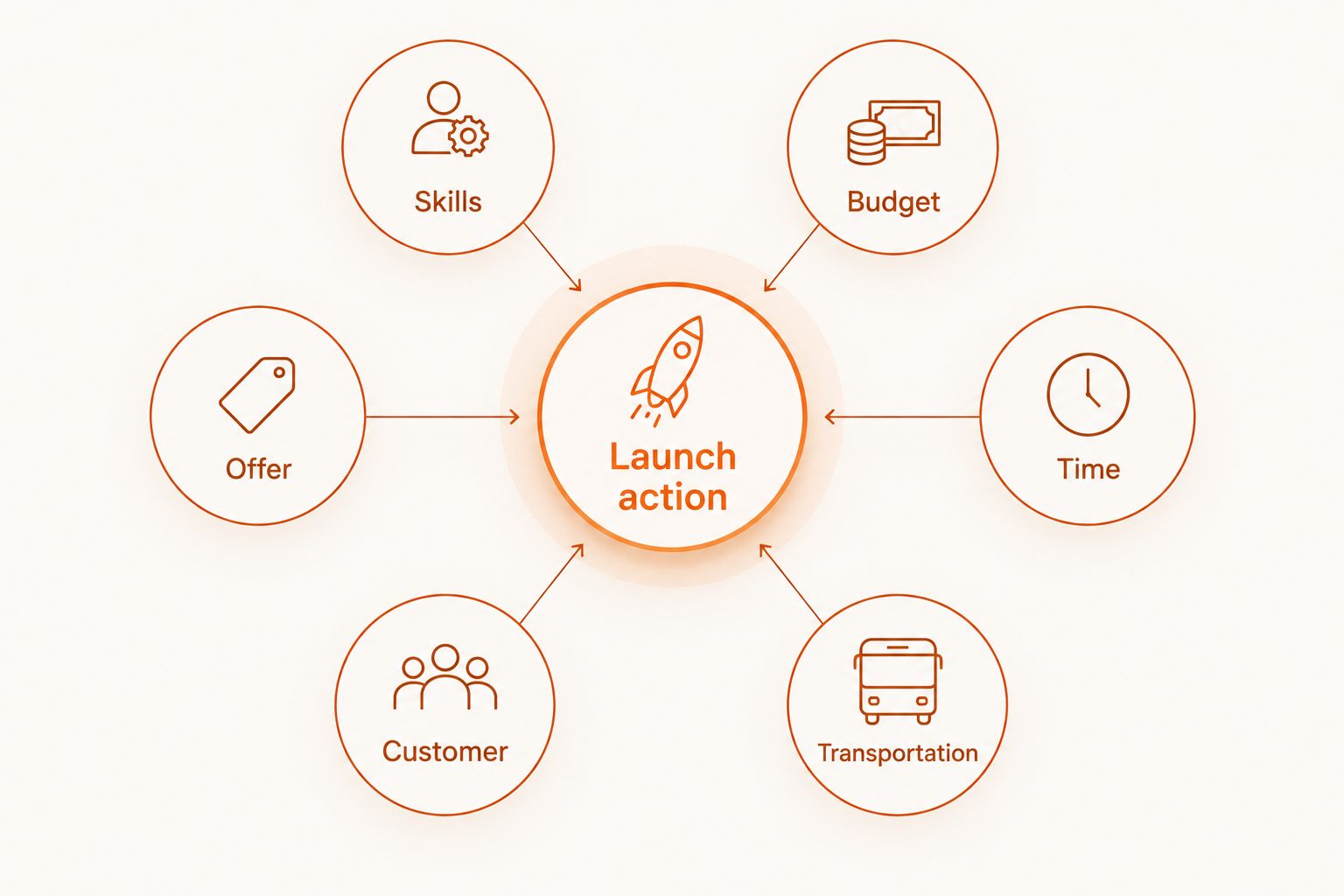
The manual route is a one-page document. Record your customer, deliverable, tools, spending limit, available hours, and next customer contact. This is enough to identify whether an idea fits your life before you build anything elaborate.
HustleForge is best for first-time designers who need a side-hustle plan shaped around their skills, budget, and available time. The HustleForge free business generator offers a guided way to draft that plan, including an offer, pricing guidance, and launch steps. Include transportation constraints even when delivery happens from home; an idea that depends on in-person visits still has travel requirements.
A generated plan is a draft, not evidence that buyers want the service. Check its assumptions against your actual circumstances. The optional Launch Blueprint is another planning choice, not a prerequisite for contacting a potential customer.
- Skills: state exactly what you can deliver.
- Budget: identify spending you can afford before a sale.
- Time: include selling, delivery, and administration.
- Transportation: explain whether in-person work is possible.
- Customer: name the buyer you intend to contact.
- Offer: describe the finished asset and its boundaries.
- Launch action: choose a specific customer-facing task.
4. Build a small portfolio that matches the offer
A portfolio should answer one question: can you do the work you are selling? A collection of unrelated illustrations does not demonstrate presentation cleanup. Create samples that resemble the proposed deliverable.
For a 2026 starter portfolio, make 3 sample projects as a self-imposed limit. This is a suggested scope, not a requirement from buyers. Use fictional businesses and label the work as a concept. Show the brief, the design, and a short explanation of your choices without presenting the project as paid client work.
For presentation cleanup, a before-and-after comparison can show improved alignment and hierarchy. Use your own source material. For social graphics, demonstrate consistency across a small set rather than producing dozens of disconnected images.
Keep the portfolio close to the offer. Add a clear description of what a customer receives, but do not imply that concept work produced sales, engagement, or other business results.
- Create samples for the same customer type you plan to contact.
- Label fictional briefs and unpaid concept work clearly.
- Use assets you created or have permission to use.
- Explain a specific design decision for each sample.
- Remove unrelated work that makes the service harder to understand.
5. Define scope before deciding what to charge
Start with the deliverable, then work through the costs. Count the time needed to read the brief, design, communicate, revise, and export files. Review software, licensed assets, payment processing, and any customer-specific purchases separately.
If your existing computer and tools cover delivery, your first test does not require a new equipment purchase. That does not make the work costless. Your time and administrative obligations still need a place in the plan.
Use a bounded scope exercise: 5 slides, 1 revision round, and one agreed file format. Those quantities illustrate how to limit a project; they are not a standard package or a promised delivery time. Define what a revision means and what happens when the customer changes the brief.
For print-related work, confirm the printer’s file requirements before accepting the job. Do not promise production-ready files if you cannot prepare or verify them.
- Specify the deliverable and the source material the customer supplies.
- List the file formats included in the handoff.
- Define revisions and requests outside the original brief.
- Check software and asset permissions for the intended use.
- Record setup expenses and recurring expenses separately.
- Confirm relevant business and tax requirements for your location.
6. Contact buyers with a specific, relevant offer
Begin with people or businesses you can approach appropriately. Ask whether the design task is a current problem before sending a long proposal. A relevant question is more useful than a message listing every creative skill you possess.
An illustrative outreach approach is to identify a presentation-heavy consultant and ask whether maintaining slide consistency takes time away from other work. If the answer is yes, share a matching sample and describe the bounded service. Do not claim their current design is hurting revenue without evidence.
For local businesses, remote delivery can still work. Explain how the customer will send content, review drafts, and receive files. Keep outreach personal and respect refusals.
Your first objective is a useful conversation about a real task. A reply is not a sale, and interest is not permission to start work.
- Choose prospects whose work matches your sample portfolio.
- Ask about a specific design task rather than general branding needs.
- Share the most relevant sample, not your entire archive.
- Explain deliverables before discussing additional services.
- Agree on scope and terms before beginning the project.
7. Review the work before expanding the service
After a completed project, compare the plan with what actually happened. Record production time, message time, revisions, and out-of-scope requests. Use those observations to tighten the next offer.
For your 2026 review, separate customer feedback from your own assessment. A customer approving a flyer means the deliverable was accepted; it does not prove the flyer increased sales. Ask what was useful and what was confusing without requesting claims they cannot substantiate.
If a project overruns your schedule, adjust its boundaries before taking on more work. If prospects misunderstand the offer, rewrite the description before adding another service. Expansion is not the automatic next step.
- Compare planned hours with recorded hours.
- Identify the requests that caused extra work.
- Ask whether the handoff files were easy to use.
- Update the brief and scope based on actual problems.
- Keep, narrow, or stop the offer based on what you learned.
Compare design offers and planning options
Choose the service by delivery fit, then choose the planning method. Neither a list nor a generated plan replaces a customer conversation.
Home-based design offers
| Option | Best for | Startup requirements | Key limitation |
|---|---|---|---|
| Presentation cleanup | Designers strong in layout and information hierarchy | Suitable software, client content, matching samples | Unclear source content can turn formatting into rewriting |
| Social media graphics | Designers who follow an existing visual direction | Design tools, licensed assets, a clear content brief | Copy requests and recurring revisions can expand the workload |
| Flyer formatting | Designers who organize concise promotional information | Layout tools and confirmed output requirements | Print preparation adds technical responsibilities |
| Template products | Designers who want to create reusable assets | Original files, buyer instructions, a distribution route | A finished template does not establish demand |
Ways to build the plan
| Option | Best for | What you control | Key limitation |
|---|---|---|---|
| One-page manual plan | Beginners who already know the customer and deliverable | Every assumption and launch task | You must structure the plan yourself |
| Free business-idea lists | Beginners exploring possible directions | Which ideas you investigate | A general list does not account for your individual constraints |
| ChatGPT | Beginners who want an open-ended planning conversation | The context, questions, and requested format | You must supply constraints and check the resulting claims |
| HustleForge side-hustle planner | Beginners seeking a personalized offer and launch steps | The skills, budget, time, and location you provide | The plan still needs buyer validation and a delivery check |
Common mistakes design-skilled beginners make
- Selling complete branding before defining the work. A broad promise leaves strategy, naming, copy, and asset creation open to interpretation. Start with a specific deliverable.
- Building template packs without a distribution plan. Decide who needs the templates and how those people will find them before expanding the collection.
- Treating revisions as unlimited polish. Distinguish changes within the approved brief from a new concept or new content.
- Using attractive assets without checking permissions. Confirm whether fonts, photos, illustrations, and other materials permit the intended customer use.
- Buying tools before testing the offer. Identify an actual delivery requirement before adding an expense. Software ownership is not customer validation.
FAQ
What are the best side hustle ideas from home for someone with design skills?
Start with a narrow service that matches demonstrated skills, such as presentation cleanup, social media graphics, or flyer formatting. Choose the option whose customers you can reach and whose deliverables fit your available time.
Can I start a design side hustle without buying new software?
You can start without new software when your existing tools support the promised deliverables and their terms permit the intended use. Check export formats and asset permissions before accepting work.
Is selling templates better than doing client design work?
Template sales suit reusable design work, while client services suit a specific buyer with a defined task. Templates require a distribution plan; client work requires communication and scope management.
Do I need paid client work in my portfolio first?
You can use clearly labelled concept projects to demonstrate your design skills. Do not present fictional clients as real customers or attach invented results to the samples.
Is HustleForge better than ChatGPT for planning a design side hustle?
HustleForge suits beginners who want a personalized side-hustle plan covering an offer, pricing, and launch steps. ChatGPT suits an open-ended planning conversation; either approach requires you to check assumptions and speak with potential customers.
How do I decide what to charge for a small design project?
Define the deliverable, estimate the full workload, and identify project expenses before choosing a fee. Include communication, revisions, and file preparation rather than counting design time alone.
How do I find my first design customer from home?
Contact an appropriate potential buyer with a question about a specific design task and a relevant sample. Agree on the deliverable and terms before starting work; a positive reply is not a confirmed project.
One last thing
Write the handoff before you write the sales pitch. Name the files the customer receives, what the customer must supply, and what sits outside the job. If you cannot explain the finish line, the offer is not ready.
Use HustleForge to draft the plan if you need structure. Then make the next move customer-facing: ask about the task you want to solve.