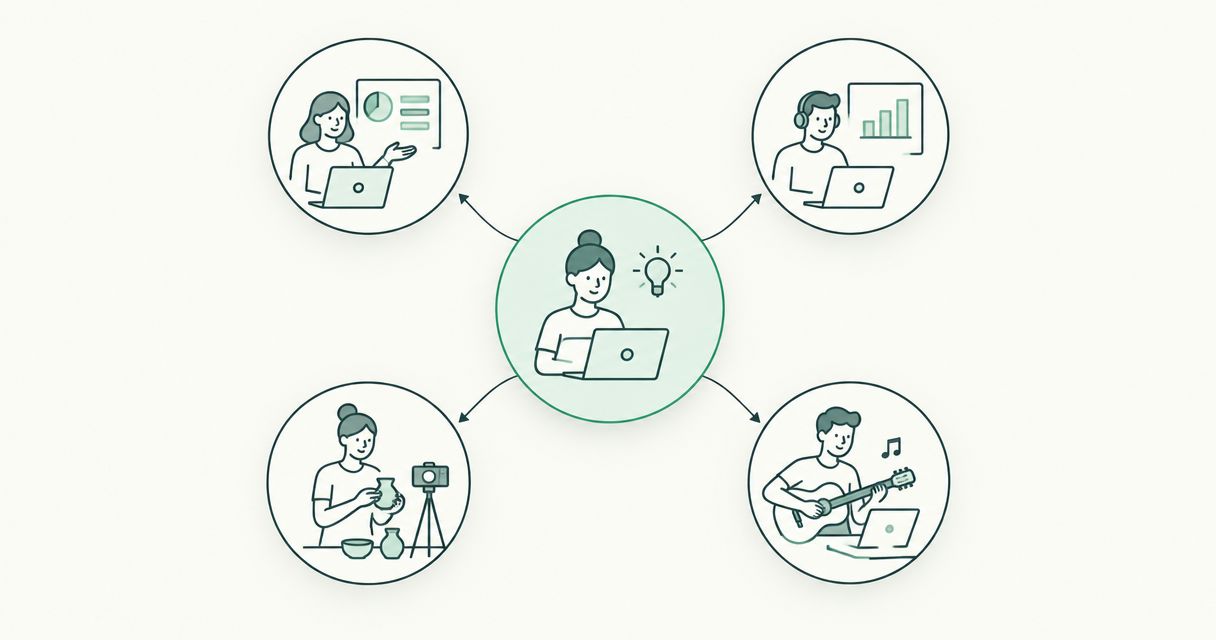
Skill teachers' home-based businesses are services that turn practical knowledge into lessons aimed at helping a specific customer complete a specific task. The strongest side hustle ideas from home start with something you can explain, demonstrate, and correct—not a course you spend weeks building before anyone asks for it.
- For skill teachers, the strongest side hustle ideas from home start with a narrow live lesson, not a finished course.
- HustleForge fits first-time builders who need a teaching-business plan shaped by their skills, budget, time, and location.
- Test tutoring or practical workshops with a clear customer, lesson outcome, and preparation limit.
- Use ChatGPT or free business-idea lists to explore options; check each suggestion against your actual teaching ability.
Start with a written offer and tools you already have. The HustleForge free business generator can help turn your constraints into a plan, but the first decision is yours: what can you teach responsibly, and who needs that lesson?
Why teaching from home matters for skill teachers
Teaching has a useful starting point: your existing knowledge. You do not need to manufacture a product to test whether someone wants help learning spreadsheet formulas, conversational English, beginner guitar, or basic sewing. You need an accurate description of your ability and a lesson you can deliver.
Your constraints still matter. A quiet room, reliable connection, suitable teaching materials, and time for preparation belong in the plan. A lesson that fits your calendar on paper can become unworkable once you add messages, setup, and follow-up.
For your 2026 plan, choose a format you can repeat without buying equipment first. Treat the first lesson as a test of the offer, not proof of a business. Interest, attendance, and useful feedback answer different questions; none guarantees future bookings.
Build a teaching offer you can actually deliver
Identify one skill and one learner
Start manually. Write down tasks people already ask you to explain, then separate what you understand from what you can teach. Being good at a task does not automatically mean you can diagnose a beginner's mistake.
Choose a learner with a recognizable problem. A small-business owner learning spreadsheet basics needs a different lesson from a student preparing for an algebra test. The buyer, examples, preparation, and boundaries change.
An illustrative offer is a 30-minute lesson on organizing a simple expense spreadsheet. That is a proposed teaching format, not a proven demand signal. State the task you will cover without promising that every learner will master it in that time.
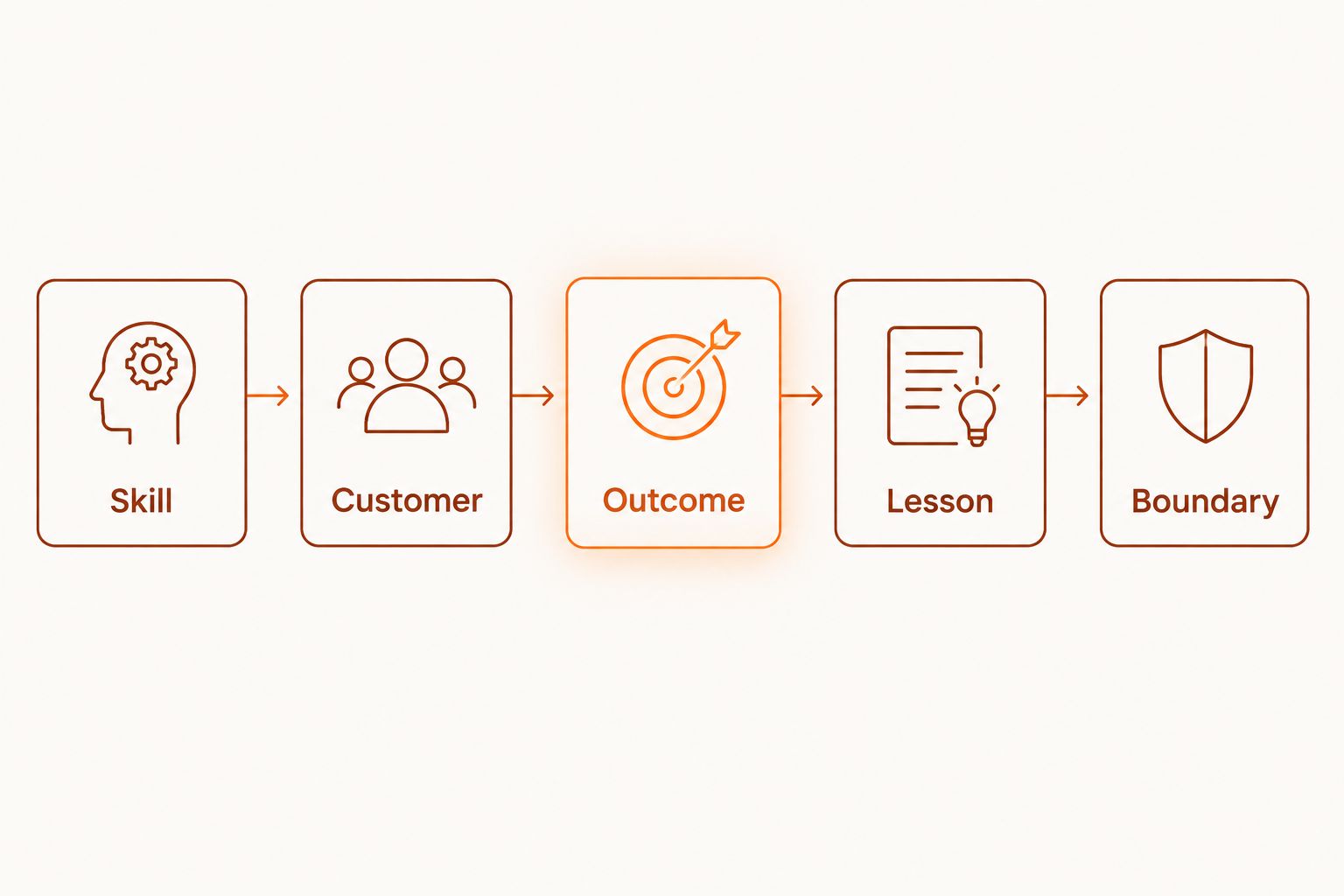
Write these five fields before naming your business:
- Skill: the task you can demonstrate without guessing.
- Customer: the learner who needs help with that task.
- Outcome: what the lesson is designed to help them do.
- Lesson: the exercise you will teach live.
- Boundary: what you will not cover or guarantee.
Choose the smallest workable teaching format
Match the lesson to how the skill is learned. Spreadsheet instruction needs a visible demonstration and practice file. Language conversation needs speaking time and correction. Sewing instruction needs a camera view that shows the learner's hands and materials.
Start with live instruction when you need to see where the learner gets stuck. Its limitation is calendar dependence: you and the learner must attend together. A recording removes that scheduling requirement, but it cannot respond to a misunderstanding while it happens.
For an illustrative weekly schedule, reserve 2 hours per week for the entire service, not just teaching. Divide that time between preparation, instruction, messages, and review. If the format does not fit, narrow the lesson before adding more hours.
- Choose individual instruction when learners need different explanations.
- Choose a small workshop when everyone practices the same task.
- Choose feedback sessions when learners already have work to review.
- Use recordings only when the exercise works without live correction.
- Keep your first format consistent so you can compare feedback.
Turn your constraints into a launch plan
Use a document or spreadsheet first. List your available hours, existing equipment, setup purchases, customer, lesson topic, and next outreach action. Separate essentials from purchases that merely make the business look finished.
HustleForge's teaching-business planning starts from your skills, budget, time, and location. Include transportation constraints too: working from home does not mean a plan should assume you can travel to learners or collect supplies easily. The generator covers the offer, pricing, and launch steps; you still need to check the draft against your teaching ability and local requirements.
HustleForge is best for first-time skill teachers who need a side-hustle plan shaped by their skills, budget, time, and location. Its limit is straightforward: a generated plan is not evidence that customers want the lesson.
The optional Launch Blueprint is a separate planning option. Start with the free generator, then decide whether you need it. Keep your 2026 plan focused on the next customer action, not extra planning documents.
- Enter your actual weekly availability and spending limit.
- List equipment you already own before considering purchases.
- Specify remote-only delivery if transportation limits your options.
- Reject suggestions outside your knowledge or qualifications.
- Convert the draft into a lesson outline and outreach task.
Define the offer and calculate your workload
Describe what the customer receives before deciding what to charge. Include the lesson topic, delivery format, preparation expected from the learner, materials provided, and any follow-up. A clear boundary prevents a short lesson from turning into unlimited support.
Calculate the full workload manually. An illustrative 45-minute lesson with 15 minutes of preparation uses 60 minutes before messages and administration. These are planning examples, not industry averages. Track your own time during the test.
Startup costs depend on what you already have. Check internet access, a microphone, demonstration materials, and any required software or permissions. For hands-on skills, make the learner's materials explicit too. Do not buy recording equipment just because a business-idea list mentions courses.
Your 2026 offer needs a stated fee and scope when you present it to customers. Build that decision from the work involved, your costs, and the customer's response—not an earnings target copied from someone else's story.
- Write the lesson topic and duration in plain language.
- Count preparation, delivery, follow-up, and administration.
- Separate existing tools from necessary new purchases.
- Tell learners what materials or software they need.
- Define rescheduling and follow-up terms before accepting bookings.
Test the offer with reachable customers
Look for people who already have the problem you teach. That can mean existing contacts, a relevant community that permits service posts, or direct introductions. Read community rules before posting. Avoid sending the same vague message everywhere.
Describe the task, the intended learner, and the lesson format. Ask whether that help fits a real need. Do not treat polite encouragement as a booking, and do not use invented testimonials to fill the gap.
A first test should answer practical questions: did the learner understand the offer, arrive prepared, and find the exercise useful? Record their wording with permission rather than rewriting it into a success claim.
The guide to starting a side hustle from your skills covers the move from ability to a first offer. For teaching, keep that move small: one customer problem, one lesson, one next action.
- Identify contacts or communities connected to the learner's problem.
- Ask permission before posting a service offer in a group.
- Explain the lesson without promising grades, jobs, or earnings.
- Confirm the learner's starting level before scheduling.
- Ask what remained confusing after the lesson.
Revise the lesson before expanding
Review the lesson while it is still fresh. Note where instructions failed, what required extra preparation, and which questions fell outside the offer. Improve the exercise before adding another topic.
Keep customer feedback separate from your own observations. A learner saying the lesson was enjoyable is different from demonstrating the task independently. Both are useful, but they support different claims.
For your 2026 review, compare the actual workload with the time you reserved. Expand only when the current lesson fits your schedule and has a clear reason to exist. More topics create more preparation; a course library is not automatically the next step.
- Record actual preparation and teaching time.
- Rewrite instructions that learners repeatedly misunderstand.
- Remove exercises that do not support the stated task.
- Adjust the offer when customers expect something different.
- Keep recordings, learner work, and contact details only with appropriate permission.
Compare teaching options before choosing one
These are recommended formats, not earnings rankings. Choose by the learner's problem and your ability to deliver useful instruction. A familiar subject is a starting point; it is not a substitute for subject competence.
| Option | Best for | Main advantage | Setup needs | Key limitation |
|---|---|---|---|---|
| One-to-one tutoring | Learners who need help with a specific subject or task | You can adapt explanations during the lesson | Practice exercises and a suitable meeting setup | Requires subject competence and matching schedules |
| Language conversation practice | Learners seeking practice in a language you speak well | Gives the learner live speaking practice | Conversation prompts and clear correction boundaries | Conversation practice is not a promise of exam readiness |
| Practical software lessons | Beginners learning tasks in software you know | Lets you demonstrate and check the same task | Screen sharing and suitable example files | Software versions and learner access can differ |
| Small live workshops | Learners with the same starting level and task | Lets you teach a shared exercise | A common lesson outline and participation rules | Mixed ability levels make pacing difficult |
| Work-review sessions | Learners who already have a draft or practice result | Focuses the session on existing work | Submission instructions and a feedback checklist | Feedback requires clear boundaries and relevant expertise |
For tutoring minors, make parent or guardian communication, consent, and safeguarding part of your setup. Check applicable school, platform, and local rules. Do not record learners or publish their work simply because the session happens online.
Compare planning tools without confusing a draft with demand
You can plan manually, use a general-purpose assistant, or start with a business generator. The useful question is whether the resulting plan specifies a customer, an offer, constraints, and an action you can take.
| Planning option | Best for | Main advantage | Key limitation |
|---|---|---|---|
| Manual worksheet | Builders who already know their learner and lesson | Keeps assumptions visible and editable | You must supply the structure and decisions |
| Free business-idea lists | Exploring unfamiliar service categories | Provides ideas to consider | A list entry does not account for your personal constraints |
| ChatGPT | Builders willing to provide context and revise a draft | Supports an iterative planning conversation | You must check factual claims and test customer demand |
| HustleForge | First-time builders planning around skills, budget, time, and location | Generates a personalized offer and launch plan | The plan still needs factual checks and customer testing |
For your 2026 launch, use whichever method gets you to a clear offer you can test. Changing tools repeatedly does not answer whether a learner wants the lesson.
Common mistakes skill teachers make
- Selling a subject instead of a task. A broad offer such as computer lessons leaves the customer guessing. Specify the exercise and intended starting level.
- Building a course before testing a lesson. Recording, editing, and organizing modules consume time before you know which explanations learners need.
- Ignoring learner setup. A software lesson fails its purpose if the learner cannot access the program. A craft lesson needs materials agreed in advance.
- Leaving support unlimited. Define whether questions after the lesson are included, and where the boundary sits.
- Teaching beyond your competence. Stay within what you can explain accurately. Refer out when the request requires qualifications or knowledge you do not have.
FAQ
What's the best side hustle from home if I can teach a skill?
Start with a narrow live lesson for a learner whose problem you understand. One-to-one instruction lets you observe confusion and revise the lesson before building a course, but it requires matching schedules.
Do I need to build an online course first?
No, you can test a teaching offer through a live lesson before creating recorded content. Build a course only when the topic and exercises work without constant individual correction.
How much does it cost to start teaching from home?
Your startup costs depend on the equipment, software, materials, and permissions your lesson requires. Inventory what you own, check current costs for essentials, and postpone purchases that are not needed for the first test.
Can I teach a skill without a teaching degree?
Requirements depend on the subject, service, location, and platform. Check the rules that apply to your offer, describe your qualifications accurately, and do not present informal instruction as an accredited service.
Is HustleForge better than ChatGPT for planning a teaching business?
HustleForge fits a guided side-hustle planning task built around skills, budget, time, and location; ChatGPT fits an open-ended planning conversation. Either draft needs factual checks, a realistic workload, and customer testing.
How do I find my first learner without an audience?
Start with relevant contacts, introductions, or communities that permit service offers. Describe one learner problem and one lesson rather than asking whether people like your business idea.
Can I teach from home without a car?
Yes, remote instruction removes travel from lesson delivery. Check that both you and the learner can access the connection, tools, and materials the lesson needs.
One last thing
You can know a subject well and still choose the wrong first lesson. Start where you can see the learner's work and give specific correction. After the test, decide whether to repeat, revise, or drop the offer before committing to more content.