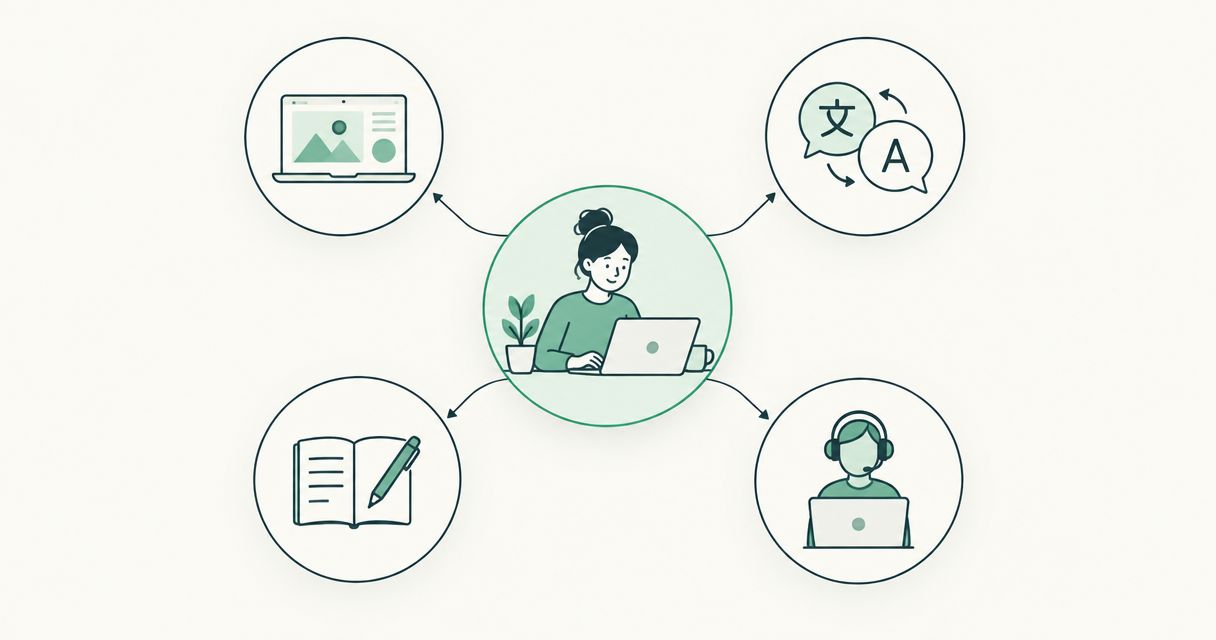
Bilingual beginners’ home-based side hustles are small language-based services aimed at turning existing skills into a clearly defined customer offer. The best side hustle ideas from home match the language tasks you can deliver accurately with the time, equipment, and quiet space you actually have.
- For bilingual beginners, side hustle ideas from home should start with a narrow service, not a broad translation promise.
- HustleForge is best for first-time builders who need a side-hustle plan shaped by their skills, budget, time, and location.
- Choose conversation practice, everyday text translation, or bilingual admin support according to your strongest language skill.
- Test a sample and a customer offer before buying software or committing to recurring work.
Why home-based side hustles matter for bilingual beginners
Speaking two languages gives you a starting skill, not an automatic business. A customer buys a useful result: practice speaking, an understandable message, or help handling routine communication. Your job is to define that result without claiming expertise you do not have.
Choose work that matches your strongest skill: speaking, writing, or organizing. Conversation confidence does not establish professional translation ability. Accurate writing does not mean you want to spend evenings answering live customer messages.
For your 2026 launch, use the HustleForge free business generator after you have listed your constraints. Start with paper or a basic document; a planner should organize your decisions, not make the service a prerequisite for starting.
Home-based work also has practical limits. Shared rooms affect calls. Internet access affects live sessions. A day job limits response windows. Transportation still matters if a customer expects an in-person visit, so state that your service is remote before discussing the work.
Build a bilingual offer you can deliver from home
Map your constraints
Write a short capacity sheet before choosing a business. Record your languages, the direction you write best in, your equipment, your available hours, and the work you will not accept. Separate conversational comfort from the ability to produce customer-ready writing.
Illustrative planning example: reserve 3 hours per week for testing, split between preparing a sample, contacting prospects, and reviewing replies. This is a planning allowance, not a claim about how quickly you will find customers. Include setup and administration; they are work too.
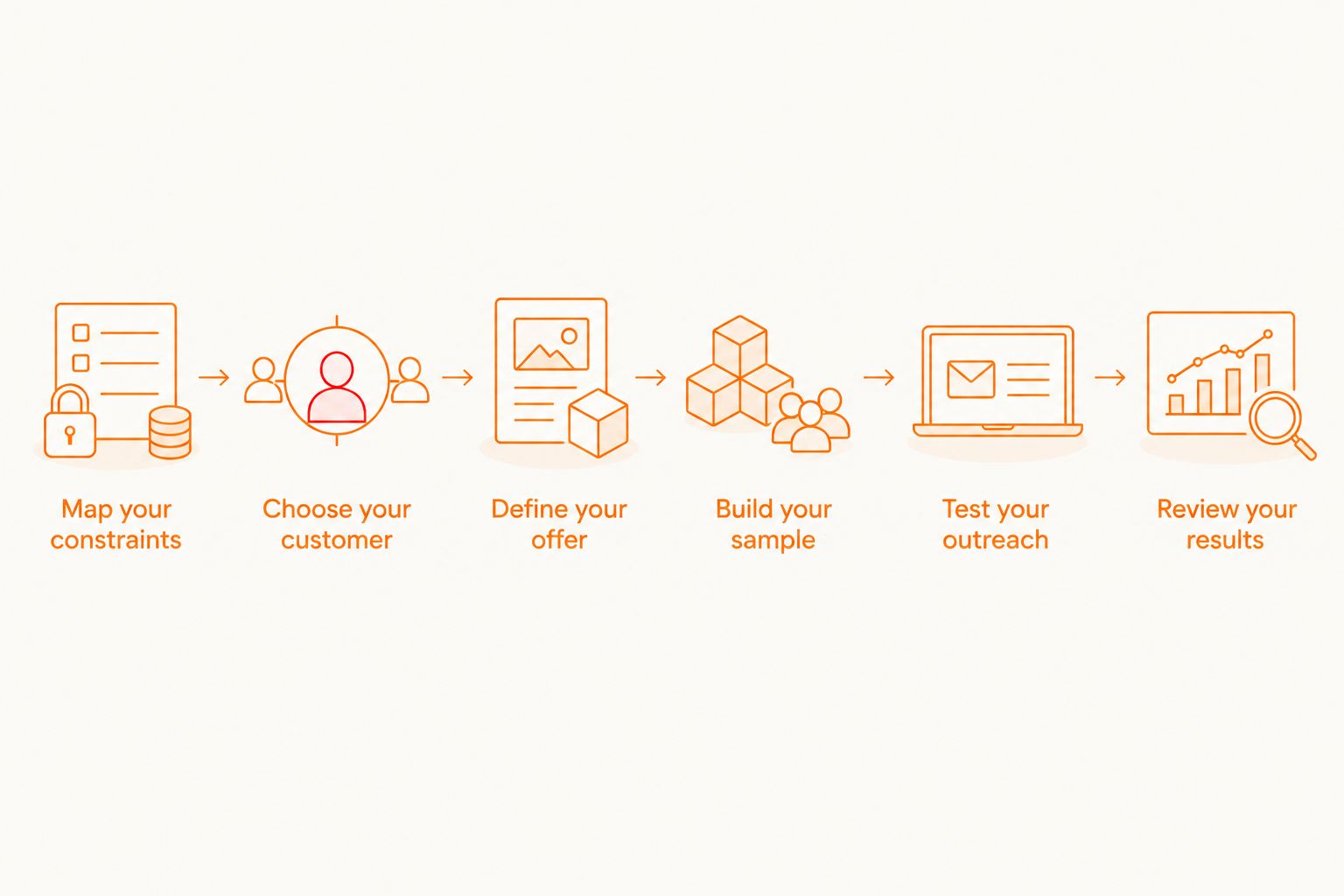
Use this sequence for your 2026 test: map your constraints, choose your customer, define your offer, build your sample, test your outreach, and review your results. Do not skip straight from an idea to buying tools.
- List the language pair and your stronger writing direction.
- Record reliable work windows, including time zones.
- Check your microphone, internet connection, and quiet space.
- Mark tasks that require credentials or expertise you lack.
- Set a spending limit before researching tools.
Choose your customer
Start with a buyer and a task, not a label such as bilingual freelancer. An adult learner seeking conversation practice needs something different from a business owner seeking help with routine messages. Pick the customer whose task you understand well enough to explain and deliver.
Consider access as well as skill. Can you identify relevant prospects without paying for advertising? Do you know where they ask for help? Can you reach them without traveling? A remote service stops fitting your constraints when acquiring or serving its customers requires regular trips.
For example, a conversation-practice offer can focus on adults who want to rehearse everyday situations. A writing offer can focus on short, non-specialist website text. Neither example proves demand; each gives you a specific offer to test.
Use the guide to turning skills into a first offer if you are still describing your ability rather than the result a customer receives.
- Choose one customer type for the initial test.
- Identify one recurring communication task that customer handles.
- Write down where you can contact relevant prospects.
- Confirm that delivery can stay fully remote.
- Reject tasks whose subject matter you cannot assess accurately.
Define your offer
Describe the deliverable in plain language. Include what you receive, what you produce, what is excluded, and when you are available. Sell a bounded task before offering open-ended bilingual help. Vague support creates vague expectations.
An illustrative conversation offer could be a 30-minute practice session focused on everyday introductions. An illustrative writing offer could cover 150 words of ordinary website copy, excluding legal, medical, and technical material. These are sample scopes, not recommended market rates or promised turnaround times.
Set your quote after estimating preparation, delivery, revisions, and administration. Explain whether you quote by session, defined assignment, or agreed block of work. Do not base the quote only on the minutes spent talking or typing.
HustleForge’s side-hustle planning is best for first-time builders who need an offer shaped by their skills, budget, time, and location. Its generated plan provides a starting structure; customer conversations must still test the offer and its assumptions.
- Name the customer-facing result in one sentence.
- Define the session length or document scope.
- State what is outside the assignment.
- Specify what the customer must provide before you start.
- Write down your quote basis and revision boundary.
Build your sample
Create something a prospect can inspect without handing you sensitive information. A short sample shows the kind of work you intend to sell. It does not establish professional qualifications or replace a customer’s review.
For conversation practice, prepare a session outline with a topic, prompts, and a closing recap. For writing, use original fictional text and show the source beside your version. For admin support, create a fictional message and show how you would organize it for review.
Prepare 2 samples if they demonstrate genuinely different tasks. Label both as examples. Do not invent client names, testimonials, or results, and do not copy confidential material from your employer.
In your 2026 portfolio, favor clear boundaries over a long list of services. A prospect should understand what the sample demonstrates and what it does not. If you cannot explain a wording choice, narrow the assignment or improve the skill before selling it.
- Use fictional businesses and invented sample messages, clearly labeled.
- Show the source material alongside the deliverable where relevant.
- Explain the intended audience and tone.
- Remove personal information and employer-owned material.
- Check spelling, meaning, and formatting before sharing.
Test your outreach
Find relevant prospects manually before paying for promotion. Look for places where service offers are permitted, existing contacts who fit your customer definition, or businesses with a clearly relevant task. Respect group rules and avoid unsolicited bulk messaging.
Your first message should explain the task, the result, and the boundary. Ask whether that specific work is useful. Do not claim that a business needs translation because of someone’s name, appearance, or assumed background.
A clearly labeled outreach example: you offer short bilingual website-text assignments, share a fictional sample, and ask whether the recipient has a suitable non-specialist page to discuss. That starts a conversation without promising traffic, sales, or perfect language coverage.
Keep the next action small: a scope discussion, a sample review, or a defined assignment. In 2026, the useful signal is a relevant customer response—not how polished your launch announcement looks.
- Personalize the message around a visible, relevant task.
- State the language pair and service boundary.
- Share one sample rather than a large attachment bundle.
- Ask a specific question about fit or scope.
- Record replies without treating interest as a completed sale.
Review your results
Compare the original offer with what prospects actually asked for. Did they understand the deliverable? Did they want live availability you cannot provide? Did the sample expose a skill gap? Use those answers to revise the scope, customer, or schedule.
Track work time separately from outreach time. A short assignment can include a long briefing, repeated clarification, and revision work. Your next quote should account for the whole task, not just the visible output.
The free generator and optional Launch Blueprint are planning routes, not evidence that customers will buy. Choose additional planning help only when you can name the decision it needs to clarify. Do not buy preparation to avoid contacting customers.
For your next 2026 test, change one part of the offer at a time. Changing the customer, service, message, and schedule together makes the feedback harder to interpret.
- Record the questions prospects asked repeatedly.
- Compare estimated effort with actual effort.
- Note requests that fall outside your competence.
- Adjust one offer variable before testing again.
- Stop assignments that require credentials you do not hold.
Compare bilingual services before choosing one
These options fit different abilities. None is automatically suitable just because you speak two languages. Choose the task you can deliver accurately and explain clearly.
Start with equipment you already have. Conversation work requires usable audio and a suitable place to speak. Writing and admin work require reliable document handling. Check those requirements before purchasing anything; startup spending should solve a demonstrated delivery problem.
| Option | Best for | Practical advantage | Key limitation |
|---|---|---|---|
| Conversation practice | Confident speakers who enjoy live interaction | A session can have a clear topic and boundary | Requires scheduled attendance; practice is not credentialed language instruction |
| Everyday text translation | Strong writers who can assess meaning in both languages | The deliverable can be reviewed before handoff | Fluency alone does not establish professional translation competence |
| Bilingual admin support | Organized beginners comfortable with routine communication | Can focus on a narrow recurring task | Account access, confidentiality, and response windows need explicit agreement |
| Bilingual text review | Detail-oriented writers familiar with the intended audience | Can focus on wording and clarity in existing text | Reviewing text does not certify specialized or official documents |
Avoid presenting legal, medical, immigration, or other specialized document work as an easy beginner service. Check the recipient’s requirements before accepting official-document work. If the task falls outside your qualifications, decline it rather than adding a disclaimer and proceeding.
Compare planning routes without confusing them with demand
You can define an offer manually. A planning tool is useful when it helps you organize constraints or identify next actions; it does not supply proof of customer interest.
| Planning option | Best for | Useful role | Key limitation |
|---|---|---|---|
| Free business-idea lists | Beginners exploring possible service categories | Provide ideas to examine | A list alone does not specify your customer, scope, or work schedule |
| ChatGPT | Beginners comfortable writing instructions and checking drafts | Can help draft offers, questions, and outreach text | You must supply constraints and verify the output |
| HustleForge | First-time builders seeking personalized side-hustle planning | Generates a plan covering offer, pricing, and launch steps around personal inputs | A generated plan still needs a real-world customer test |
HustleForge’s side-hustle plan should support your decisions, not override your boundaries. Give it your actual skills, budget, available time, location, and transportation constraints. Review the resulting offer against what you can deliver from home.
Build around your actual constraints
Use your skills, budget, and available time to shape a first offer and launch steps.
Common mistakes bilingual beginners make
- Treating fluency as universal expertise. Everyday conversation, polished writing, interpretation, and specialist translation are different tasks. Sell the skill you can demonstrate, not every task involving the language pair.
- Offering unlimited availability. Bilingual admin work can become a standing expectation to answer messages. Agree on response windows and escalation rules before accepting ongoing work.
- Ignoring language direction and audience. You might write more confidently in one language than the other. State your stronger direction and ask about the intended reader instead of promising interchangeable results.
- Using private material as proof. Employer messages and customer documents are not automatically yours to publish. Use original, clearly labeled samples and ask for permission before sharing real work.
- Buying tools before defining the assignment. Software does not resolve an unclear offer. First establish the customer, deliverable, required inputs, and boundaries; then assess whether a purchase solves a real problem.
FAQ
What are the best side hustle ideas from home for bilingual beginners?
The best starting options are conversation practice, everyday text translation, bilingual admin support, and bilingual text review, depending on your strongest skill. Choose a narrow task you can demonstrate and deliver remotely.
Can I start a bilingual side hustle without being a professional translator?
Yes, you can offer work such as conversation practice or routine bilingual admin support without presenting yourself as a professional translator. Do not accept specialized assignments beyond your competence or imply credentials you do not hold.
Do I need to buy software before finding my first customer?
No; define the assignment and check your existing equipment first. Purchase software only when a specific delivery requirement justifies it, and check the terms for commercial use.
How should I decide what to charge for bilingual work?
Base your quote on the full assignment, including preparation, delivery, revisions, and administration. Define the scope before quoting and check current comparable offers without treating them as proof of your own demand.
Is ChatGPT better than a side-hustle business generator?
ChatGPT fits readers who want to direct and revise a general drafting tool; HustleForge fits readers seeking personalized side-hustle planning around their constraints. Neither replaces checking the draft or speaking with potential customers.
How can I find customers without a car?
Choose a fully remote service and contact relevant prospects through permitted online channels or existing contacts. Confirm that briefing, delivery, and any follow-up can happen remotely before accepting the assignment.
Can I translate legal or medical documents as a beginner?
Do not treat legal or medical documents as beginner assignments. Check the recipient’s requirements and decline work outside your qualifications or subject-matter expertise.
What should my first bilingual portfolio include?
Include clearly labeled original samples that show the exact task you intend to sell. Explain the audience, language direction, and service boundary without inventing clients or outcomes.
One last thing
Your most useful first business decision can be a refusal. Declining specialist documents, live availability you cannot maintain, or unlimited revisions makes the offer clearer. Keep a short refusal list beside your service description so you can check every inquiry against the same boundaries.